The Superintendent’s Office
The Consolidated Mining & Smelting Company records of the War Eagle Mine production from 1905 to 1928.
Click for a closer look!
The Superintendent’s Office found on the upper bench of the Rossland Museum & Discovery Centre’s grounds is a reminder of an important yet often overlooked aspect of mining: the business and administration side. Superintendents worked to ensure the smooth operation of their mine, keeping track of the rates of production, organizing labour, and negotiating with investors and stockholders.
Rossland’s Role in the Stock Market: Did the Toronto Stock Exchange begin in Rossland?
“What started the great Canadian love affair with mining stocks was Rossland. By 1896 that word seemed to be on everybody’s lips on the street in Toronto and Montreal. Prospectors swarmed into the camp in the southern interior of British Columbia in search of further strikes of gold, silver, and copper. Stories about the riches of mines such as the Le Roi, War Eagle, and Centre Star filled the press. As Canada began to struggle out of the painful depression of the early 1890s, a great wave of enthusiasm mounted.
”
You may have heard the claim that Rossland was responsible for the foundation of the Toronto Stock Exchange. In fact, the Toronto Stock Exchange was first established in the 1860s, decades before the first mining camps were established on Red Mountain — but the town’s 1890s gold boom still played a pivotal role in shaping the way that mining stocks were — and continue to be — traded on Bay Street.
The discovery of copper-gold ore in Red Mountain and the promise of riches made headlines around the world. News of successful “strikes” spread to mining camps and into the growing fincancial districts in cities like Montreal and Toronto, creating the Rossland gold boom that drew prospectors, miners, entrepreneurs, and investors. Unlike the placer gold rushes of earlier decades, the Rossland mines operated with lode mining techniques — which required investment. While prospectors arrived in droves to develop the ramshackle mining camp into a bustling city, capital from the northwestern US, central Canada, and even Europe also poured into the area as investors around the world traded in Rossland mining stocks. By the mid-1890s, infrastructure like railways, hydroelectric dams, and the Trail Smelter were springing up to support the wealth that investors were confident awaited them in the depths of Red Mountain.
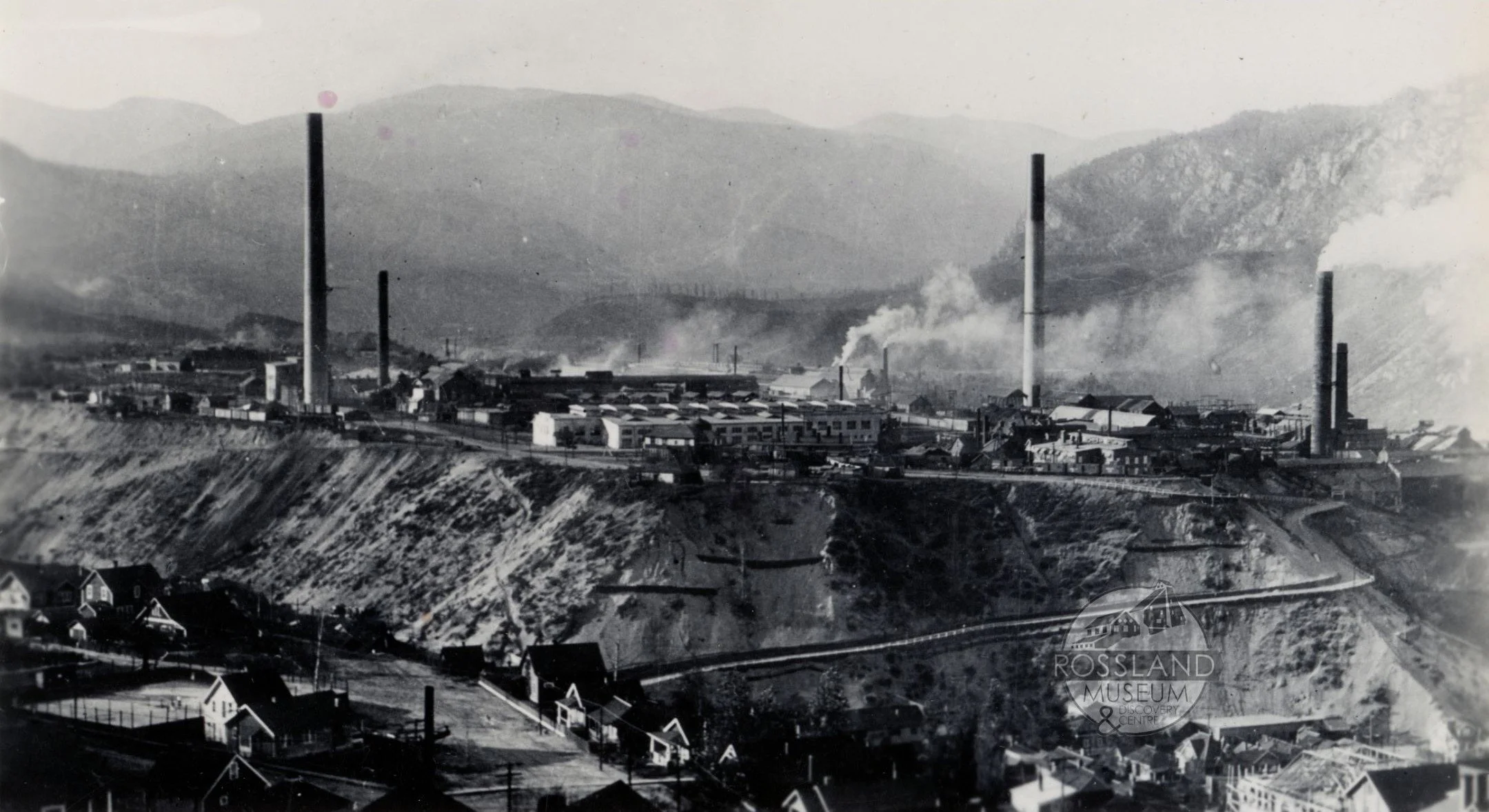
2306.0238: The Smelter at Trail, BC was built in 1896 to process Rossland’s ore
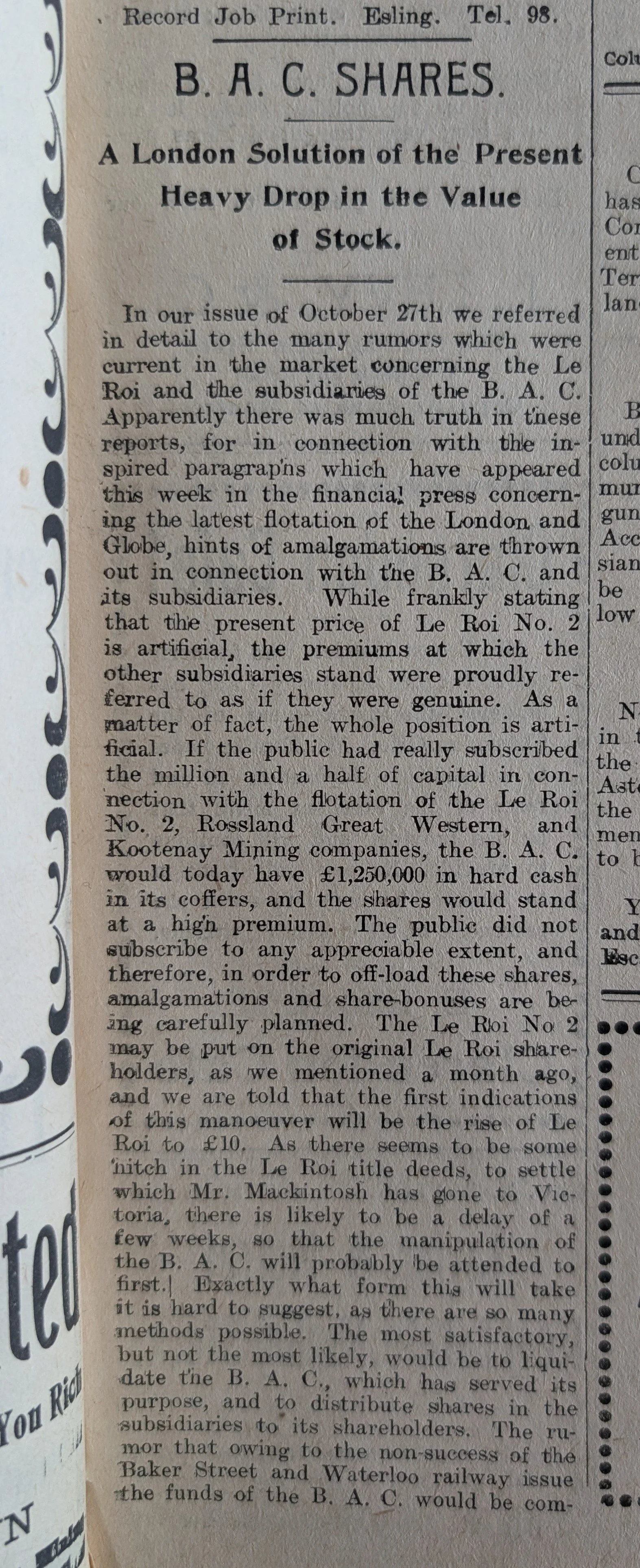
Rossland Miner, December 18, 1900. In general, the Miner was optimistic about Rossland’s wealth, and we struggled to find articles about the stock market crash that occurred in late 1900! However, this article admits, “the whole position is artificial.”
Today, investments in mining and resource extraction are key components of the Toronto Stock Exchange — but in the 1890s, the group worried that the nature of the industry made it too risky for them. This was not an unreasonable concern! Through the 1880s and ‘90s, the global market was expanding as Canadians became more familiar with investment opportunities — but shareholders had little legal protection, and access to information was often extremely limited. Publications such as Harold Kingsmill’s 1897 A First History of Rossland, with Sketches of Some of Its Prominent Citizens, Firms and Corporations were written to spread word of the new city and encourage further investment — but it was not always possible for investors across the continent to vet their sources or learn anything further about their investments.
Plenty of mining companies with stocks on the market were fraudulent — and others were just plain unlucky. Although claims were staked all over Red Mountain and the surrounding area, the “big five” mining claims (the Le Roi, the Centre Star, the War Eagle, the Josie, and the Black Bear) extracted more than 97% of the gold ultimately recovered from the Trail Creek Mining Camp. Most of the other mining claims failed to live up to their promises — and their investors suffered. Fraudsters and confidence men operated in person, through newspaper advertisements, and even through mail advertisements to solicit investments in mines that would never pay out.
As early as 1896, the Toronto Board of Trade flagged that only two mining companies in BC, the Le Roi and the War Eagle, were paying any dividends, and the vast majority of BC mines weren’t even shipping any ore. These concerns would come to a head in 1900 with the Whitaker Wright scandal, which gave Rossland a long-lasting international notoriety. In a day with little financial regulation and limited access to information, speculation in mining shares was risky!
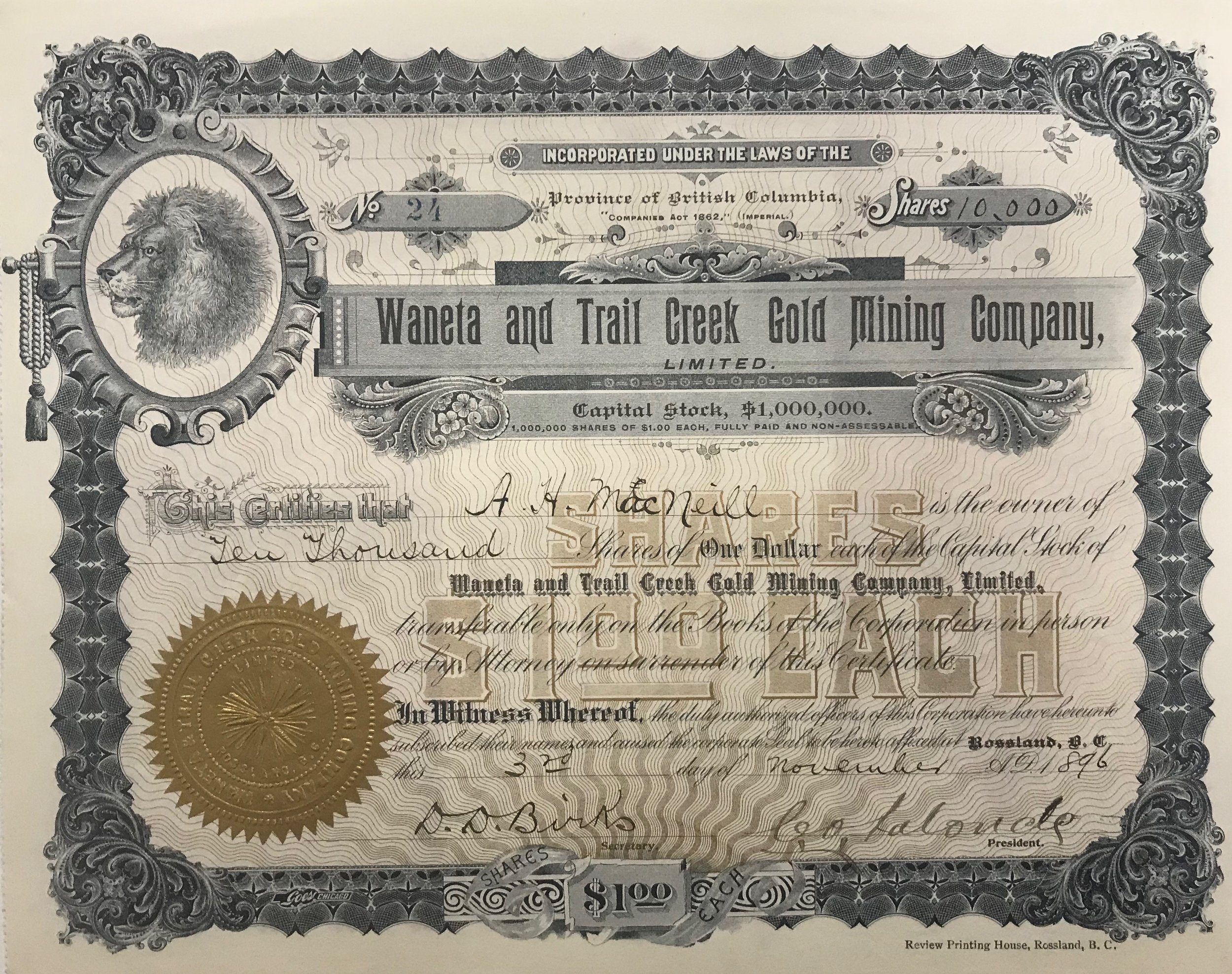
An 1896 certificate confirming A.H. MacNeill as the owner of 10 thousand shares, valued at $1 each, in the Waneta and Trail Creek Gold Mining Company. While some investors made a fortune, many less-savvy businessmen were duped!
Nevertheless, investors had an appetite for mining shares — and particularly for Rossland mines. Trading the unlisted shares through a formalized stock exchange would provide structure that might allay some fears about speculation — while capitalizing on public interest for trading mining shares. In 1897, the Toronto Stock Exchange (TSE), formerly dominated by local banks, railways, and mortage companies, decided to get in on the market for Rossland shares by offering trade in unlisted mining shares twice daily. Later, TSE even began to list certain reputable mining companies — starting with Rossland’s War Eagle mine in 1898.
“When Toronto finally began to challenge Montreal as a national, and not merely a regional, metropolis, securities markets in the nation’s second city started to reflect its new status. Nowhere was the impact of the Rossland mining boom more evident.”
In spite of these concessions, demand for trade in mining shares still exceeded supply by the TSE, and a group of stockbrokers established a new Toronto Mining Exchange which began operations in 1898. The following year, yet another exchange was established: the Standard Stock Exchange. By early 1901 — with Rossland’s boom past its height — the Toronto Mining and the Standard Stock Exchange had amalgamated under the new name Standard Stock and Mining Exchange. This group, with its foundations and focus on trading shares in mineral extraction, would go on to be the major rival of the Toronto Stock Exchange until 1934, when the Standard merged to become the mining section of the TSE.
A map of the mine claims of the Rossland area, circa 1923. Note how many bike and ski trails have gained their names from these stakes! (Click for a closer look)
Mine Claims
An important aspect of the bureaucratic side of mining is the process of staking mining claims. Mine claims permit a prospector/company to extract the minerals from the claimed parcel of public or crown land. This does not give them exclusive rights to use the surface land, but allows for the development of mining operations and the extraction of accessible minerals. Over 2000 claims were made in the greater Rossland area, however, roughly 97% of the ore produced came from just five of these mines: the Le Roi, the Centre Star, the War Eagle, the Black Bear, and the Josie.

Photo 2304.0155: The Josie Mine superintendent’s quarters. Circa 1900.
Moris, Bourgeois, and Topping
The first claims in Rossland were made by two French-Canadian men by the names of Joe Moris and Joseph Bourgeois, who had heard rumours of great possibilities for gold within Red Mountain. Travelling the Dewdney Trail, the two men staked 5 claims on the mountain in the summer of 1890, taking 10 samples to be assayed in Nelson. Only some of the core samples showed much promise, but the men decided to register their claims and try their luck anyway. Unfortunately, they faced a few obstacles, the first being that the laws of the time only allowed a prospector to stake 2 claims maximum, and the second that the registration fee was more than they could currently afford. As such, the duo struck a deal with the assayer they had hired, Eugene Topping, wherein he would pay the claim registration fees ($12.50 total), and in exchange, they would give him one of their claims - the “Le Wise.” Topping accepted the deal, renaming his claim the Le Roi. The Le Roi claim and subsequent mine became the most profitable of all the Rossland mines. However, Moris and Bourgeoise could hardly complain, as each of their two claims became worth roughly $15 million within the next 5 years.
The Columbia Basin Institute for Regional History has created a short click-through exhibit about Angus Davis! A mineral engineer who worked in the Rossland gold camps, Davis was known as a legend in the field. The Memoirs of Angus Davis were completed shortly before the death of the author on January 24th, 1949.
Continue the Outdoor Tour: