Departmental Practice Overviews
Museums and heritage organizations are made up of interconnected areas of practice, each contributing to the care, interpretation, and sharing of cultural and historical resources. While roles may overlap in smaller organizations, understanding departmental functions helps situate individual work within a larger context.
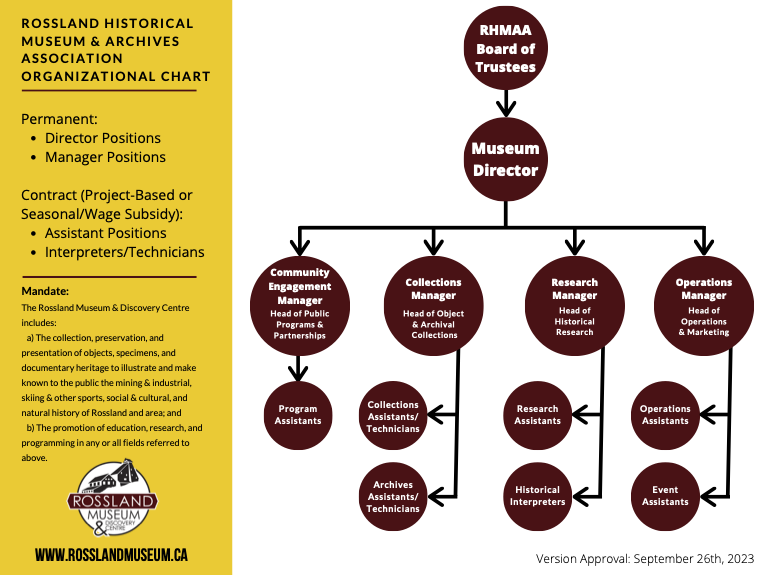
This section provides high-level overviews of key practice areas at RMDC, including Archives, Collections, Operations & Marketing, and Community Engagement. Each overview outlines the purpose of the department, typical learning areas, and transferable skills associated with that work.
Framework of Roles
This matrix outlines the professional expectations, skills, and leadership growth paths across different job categories in a community museum environment. It may help staff and early career professionals understand how day-to-day tasks scale into long-term organizational strategy.
This information was developed from resources shared by Skookum Kids.
-
Technical Skills: Functional knowledge of general museum or archive operations; focus on growing baseline professional skills, data integrity, and depth of sector knowledge.
G(etting) S(tuff) D(one): Able to execute well-defined tasks (e.g., routine cataloguing entries, visitor services, basic archival housing) and provides clarity to otherwise unrefined or initial areas of work.
Influence: Contributes positively to a collaborative, supportive team environment.
Communication & Leadership: Able to clearly articulate to visitors and the public the basics of the museum’s activities, local history, and overarching mission (what we do and why).
-
Technical Skills: Emerging mastery of their specific practice area (e.g., digital preservation, collection management, public program delivery).
G(etting) S(tuff) D(one): Able to work at a project level with little or no oversight. Knows exactly when to ask for help and is capable of correctly prioritizing competing daily tasks.
Influence: Regularly participates in the internal and professional heritage community, exerting a consistently positive influence on workplace culture.
Communication & Leadership: Able to articulate the current state, goals, and underlying reasons for at least one specific program or collection area equally well to both industry insiders and public outsiders. Translates high-level objectives into daily practice, and returns valuable feedback to leadership about front-line community context.
-
Technical Skills: Strong working knowledge of all interconnected museum operations; the go-to expert on a particular operational, curatorial, or public engagement issue. Can provide situational or on-call support across multiple departments when required.
G(etting) S(tuff) D(one): Regularly and fearlessly takes on and completes messy projects and unrefined tasks (e.g., complex grant reporting, multi-week event logistics). Completes them in a spirit consistent with the museum’s mission, values, and strategic vision with or without direct instruction.
Influence: They are regularly called upon to train, orient, and onboard newcomers or interns in their area(s) of expertise.
Communication & Leadership: Effectively communicates the museum’s value as a complete enterprise to newcomers, partners, and community groups.
-
Technical Skills: Deep, nuanced understanding of both modern heritage/archival standards and the historical or community context behind current museum conditions. Participates with other senior leaders to craft a shared vision for operational growth and proactively brings it to pass.
G(etting) S(tuff) D(one): Regularly manages difficult, complex, and sensitive museum work (e.g., ethical handling of donor relations, complex collections issues, repatriation inquiries). Takes the initiative to solve deep problems before they are formally assigned.
Influence: Broad mastery of the concepts underlying all programming, operational frameworks, and collections management. Inspires consistently high performance from colleagues and is comfortable being held accountable for whole-team outcomes.
Communication & Leadership: Has a significant positive influence on the career trajectory of the employees, interns, and volunteers reporting to them. Managers accelerate professional growth while inspiring and demanding high ethical and performance standards in heritage work.
-
Technical Skills: Takes a grand-strategy view of museum operations and community positioning. Weighs operational choices in terms of long-term institutional sustainability, cost/benefit trade-offs, and understands the indirect results of decisions across multiple degrees of separation.
G(etting) S(tuff) D(one): Puts the "S" in GSD, consistently drives major organizational breakthroughs, strategic funding streams, capital improvements, and master planning.
Influence: Sets the strategy, ethical foundation, and professional expectations throughout the organization that lead to high institutional performance alongside personal and team health.
Communication & Leadership: Champion for the museum's vision to major funders, municipal partners, board members, and the broader cultural sector.
Key Practice Areas
Archives & Research Requests
Purpose: Managing and digitizing documentary heritage, photographs, maps, and oral histories while facilitating public, institutional, and historical research requests.
Typical Learning Areas:
Applying archival arrangement and description principles (e.g., Rules for Archival Description - RAD)
Digitization workflows and maintaining digital asset metadata
Navigating public research dynamics and handling fragile historic records
Transferable Skills: Information management, database navigation, customer/researcher services, historical verification.
Collections Management
Purpose: Maintaining physical care, cataloguing, and legal stewardship of historical objects, mining technology, and material culture in trust for the community.
Typical Learning Areas:
Collection management software (data cleaning and standard nomenclature vocabularies)
Processing temporary custody, object handling, and artifact marking techniques
Monitoring storage environments (relative humidity, light levels, pest management)
Transferable Skills: Database auditing, object tracking, logistics, risk assessment, preservation awareness.
Community Engagement & Education
Purpose: Developing public programs, managing volunteer pipelines, designing school group tours, and coordinating community outreach events.
Typical Learning Areas:
Adapting complex historical or science concepts into interactive, public-facing school programming (e.g., K-12 curriculum integration)
Designing interpretive tools like public tours or outreach kits
Coordinating and supporting diverse volunteer cohorts
Transferable Skills: Public speaking, curriculum/lesson planning, project coordination, interpersonal leadership, volunteer management.
Operations & Marketing
Purpose: Driving visitor services, museum communications, marketing campaigns, retail operations, and facility administration.
Typical Learning Areas:
Content creation for social media, newsletters, and digital marketing platforms
Tracking visitor center statistics and front-of-house operational workflows
Supporting special event coordination and non-profit logistics
Transferable Skills: Digital marketing, strategic communications, financial/retail basics, customer relations, event operations.