Behind the Scenes - Archives Assistant Gabe Mann
My time here at the Museum this summer has been very valuable. I have learned a lot about archival processes and preservation, which will help me on the path to becoming a full-fledged archivist.
-Gabe
The Rossland Museum & Discovery Centre would like to thank the Government of Canada and the Canada Summer Jobs program for contributing to this paid student opportunity.
Main Projects
The main project I have been focusing on this summer is the creation of finding aids for our archives. Each collection in the archives is laid out into multiple categories, and the finding aid is meant to give an overview of what subjects each category contains for ease of access. This job consists of going through a collection and noting names of people, businesses, and subjects that can be found in the collection’s material. I have currently completed 10 finding aids this summer, the latest of which is the Rossland Board of Trade. The records we have from them span from their inception in 1896 to the early 1960s, and include minutes from weekly meetings, letters, annual reports, and lists of members. The meeting minutes in particular helped me practice reading old handwriting, which is often very difficult to decipher. Among my favourites of the collections I made finding aids for are the War Eagle Mine Collection and the Le Roi Mine Collection. Both of these contain surveys conducted by Cominco in 1941 to see if there was any more gold they could extract from the old tunnels and waste rock with new mining technology.
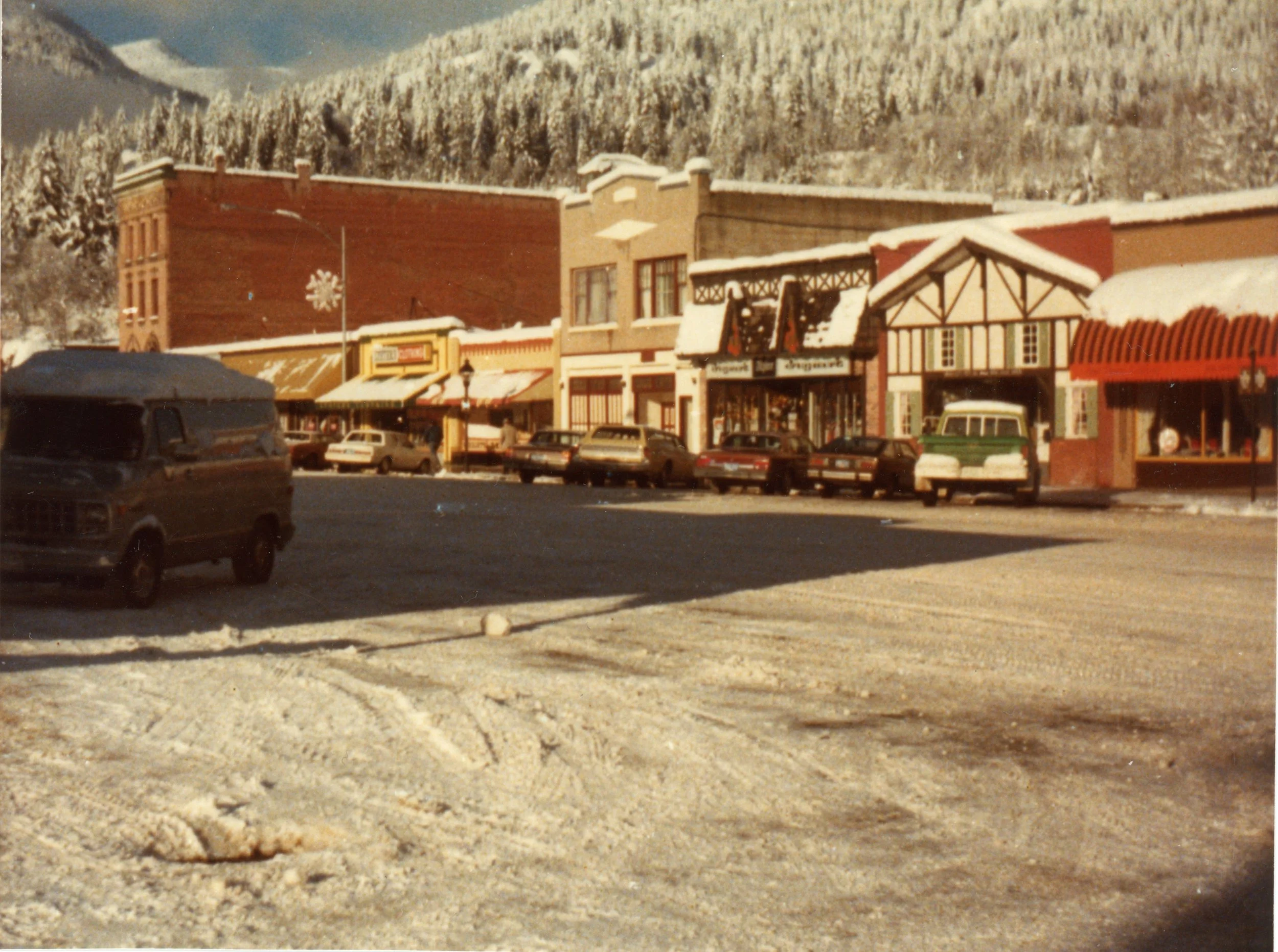
Columbia Avenue in the winter, from the Yawney Family Collection.
Another of the finding aids I worked on was for the Yawney Family Collection. This one contained quite a few interesting photographs, including old photos of Rossland and even previous Golden City Days events. However, I noticed we hadn’t been able to digitize them yet, so I decided to take on the task myself. Digitizing photographs involves scanning them at a very high resolution so we can store them in our digital archives ready for a number of potential future uses.
The other big project I worked on this summer was inventorying sections 18, 19, and 20 of our archives. Rather than being shelves which hold boxes for each collection, these sections are filing cabinets which contain material that is too bulky to put in those boxes. I was given the task of making sure we knew what was in there. There are drawers containing stock certificates from the Rossland Stock Exchange and books and binders from Cominco and various mines. The surveys from the War Eagle Mine and Le Roi Mine are among the material stored there.
Workshops
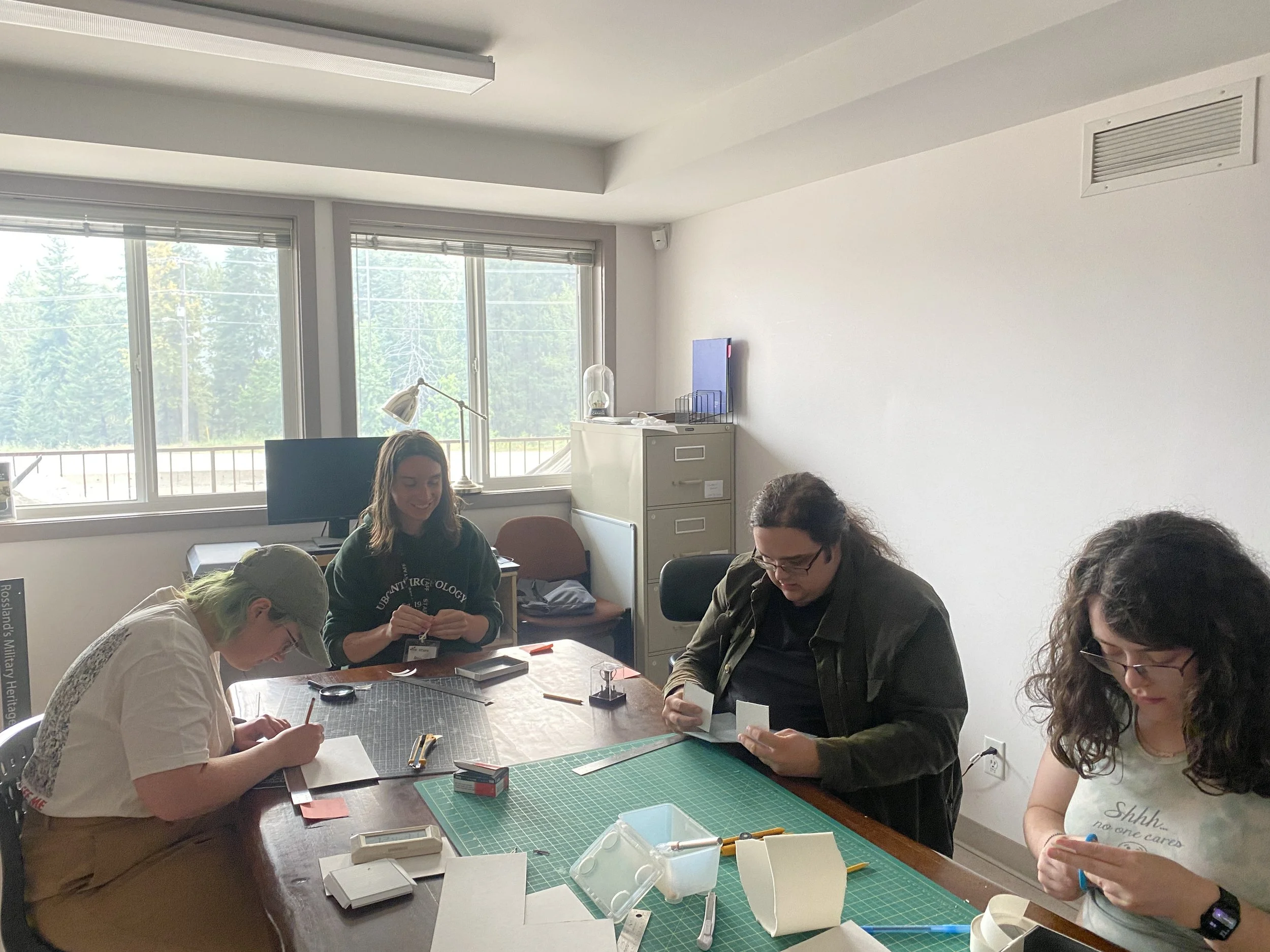
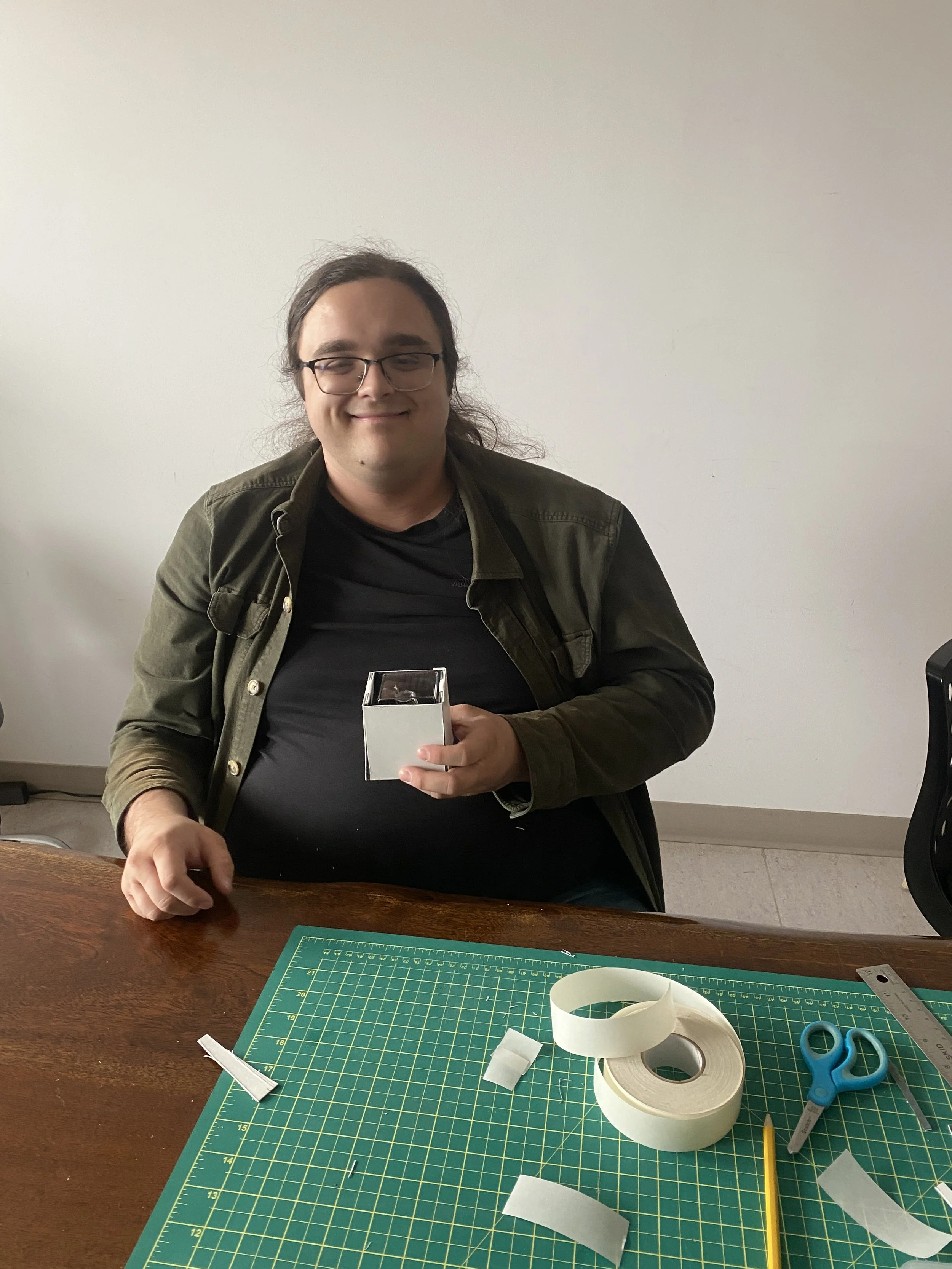
The other summer students and I participated in some workshops to learn new skills. There were 5 in total, the first of which was learning how to make boxes that were meant to hold oddly-sized artifacts. We each selected an artifact and measured its dimensions, then cut sheets of archival mat-board to the correct size. We then folded the mat-board into the shape of a box and finished by securing the edges with acid-free tape.
We also learned the ins and outs of book repair. Each of us was given a book to fix, and with mine, the front cover was separating from the pages within. It is not a good idea to use tape when repairing books, because the acid in the adhesive of most tapes will damage the book. Instead, I measured out a strip of Japanese fibre tissue to fit the gap between the pages and cover. I then covered the strip with a glue made of non-acidic methylcellulose and water. Once the tissue was fully covered in glue, I laid it into the gap while making sure to get some tissue both inside the gap and to either side so it would hold together. Finally, I placed parchment paper between the cover and the page that was repaired so it wouldn’t stick together, closed the book, and placed a weight on top to let it dry. After about a day of waiting, the glue was fully dry and the repair was complete.

Terracotta pot in the midst of gluing.
Workshop number 3 was terracotta pot repair. This one started off with us smashing some extra pots into pieces, which was quite fun. Luckily, we had the pots in bags so the pieces didn’t spread across the floor. Once the pieces were all out of their bags, the task of reconstructing them began. First, we put the pieces together like a puzzle, using tape to hold them together temporarily. Once we had the pots fully put together, we began gluing the pieces back together. We used ordinary white glue and applied it with a brush. Making the pots look perfect was not the goal; we were only trying to restore the pot’s structural stability. Also, if the pot were to break again, the glue would allow it to shatter only along the old cracks rather than creating new pieces. There were only a few small gaps on my pot left after the larger pieces were reattached to each other, but I was able to fill most of these with the smaller shards.
Another workshop I was part of was related to textile storage. We were storing large flags, which would ordinarily take up a lot of room. I took a cardboard tube that was similar in width to the flag, wrapped it in a clear, pH-neutral plastic called mylar, then wrapped the flag around that. We then wrapped all of it in a cotton fabric known as muslin, and tied it with twill tape to keep it from unravelling.
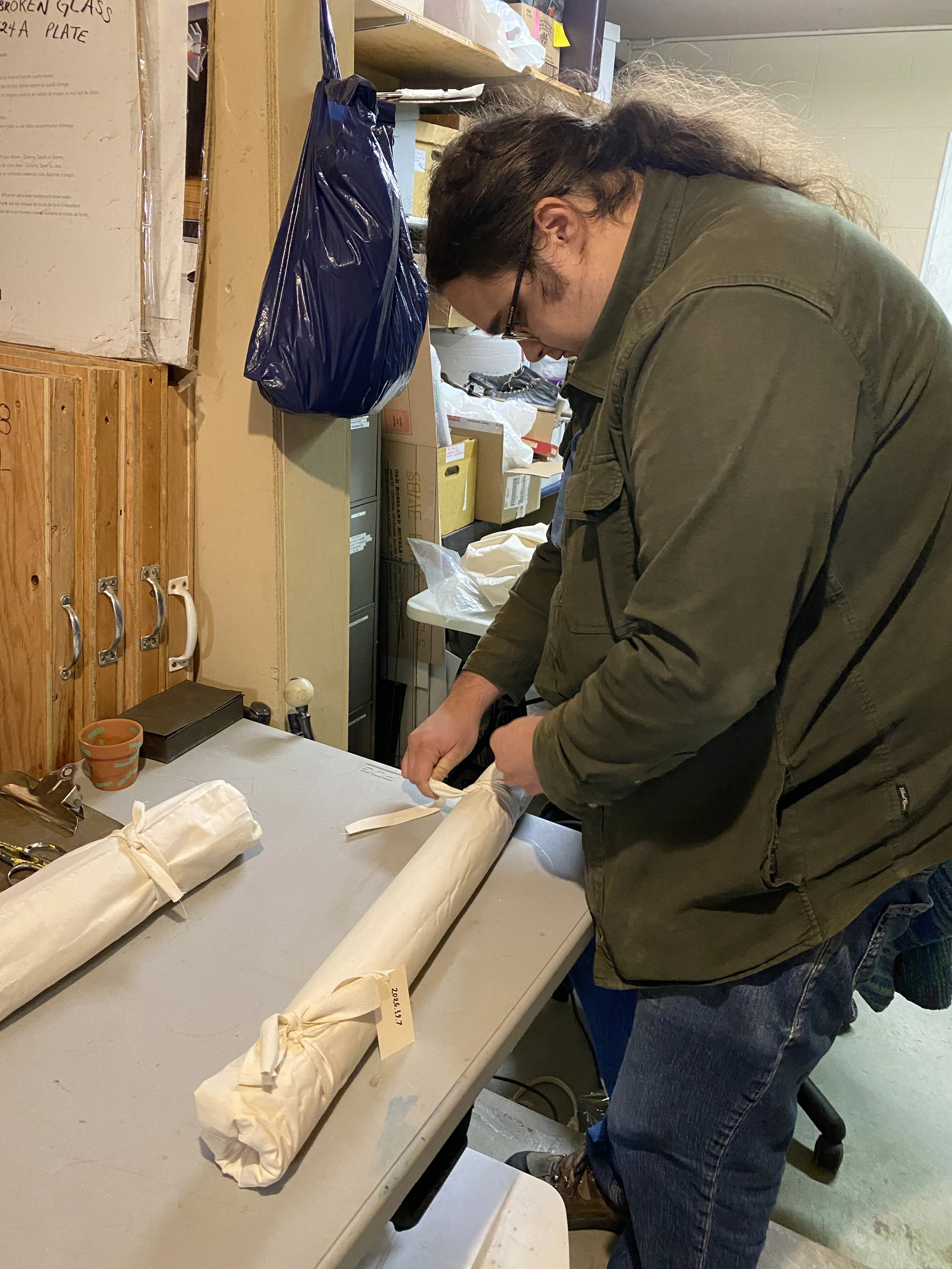
Tying twill tape around a wrapped-up flag.
The final workshop I participated in this summer was split into 2 parts: paper repair and encapsulation. Paper repair is a simple process. I started by finding any tears in the sheet. I then took acid-free tape and affixed it to the tear, making sure it was on the back side of the sheet so it would not cover up anything important. Once the tape was covering the tear, I applied pressure to make it fully set into the paper. Archival tape is good to use because it is difficult to see on white paper. The tissue we used when repairing books can also be used, but tape is easier. It is very important, however, to not use more common types of tape, such as masking tape, scotch tape, or duct tape, because their adhesive will cause the paper to deteriorate. The second skill I learned in this workshop, encapsulation, also involves paper. When you want to protect something like a postcard, photograph, or a larger sheet that might not fit into an envelope, you can encase it in mylar. This involves measuring out enough mylar to fold over the sheet and using archival double-sided tape to seal the edges. I left one side untaped to allow the postcard I was encapsulating to be removed if necessary.