Chinese New Year in Early Rossland
Researched and Written by Aaron Wickberg, Archival Research Coordinator. Edited by RMDC
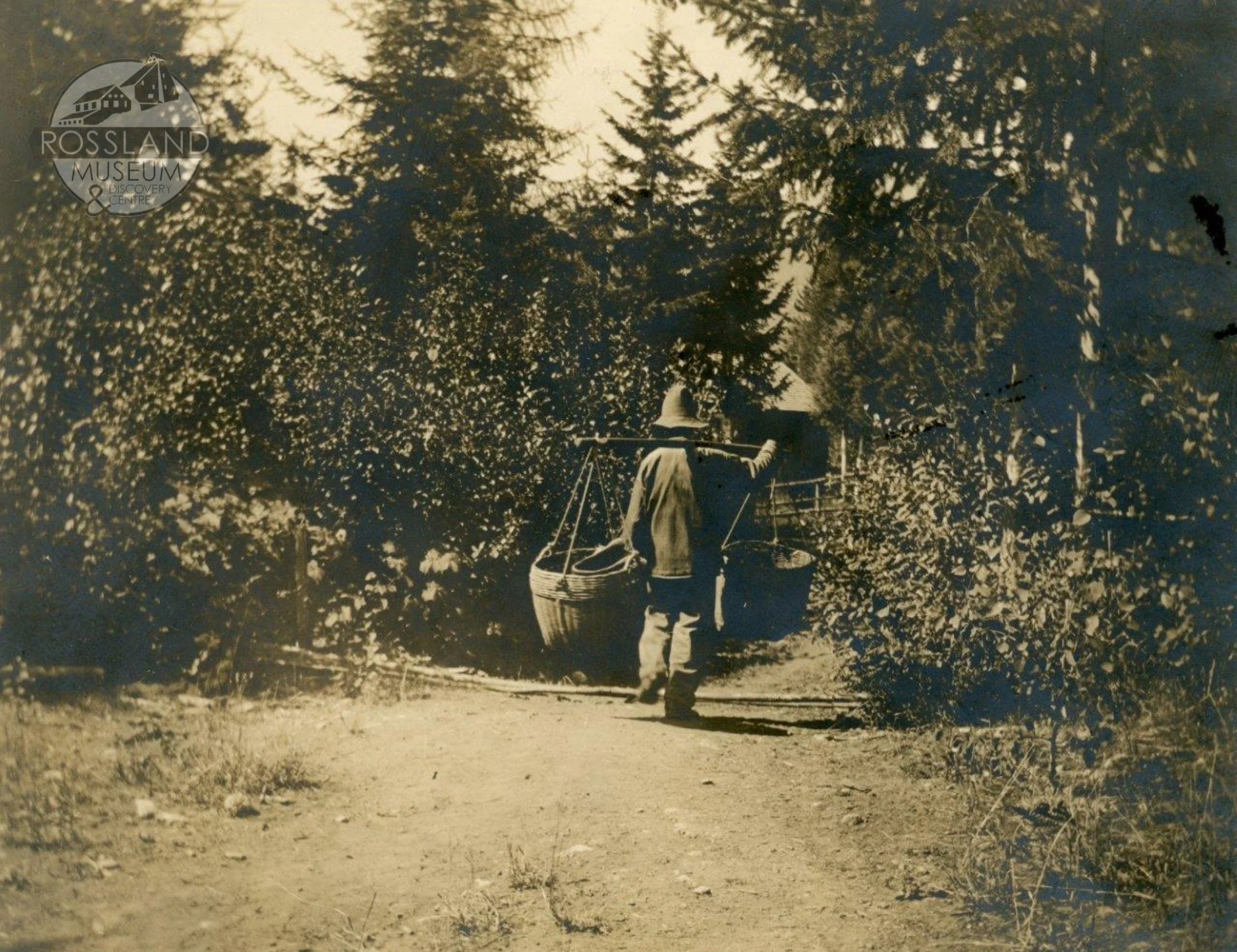
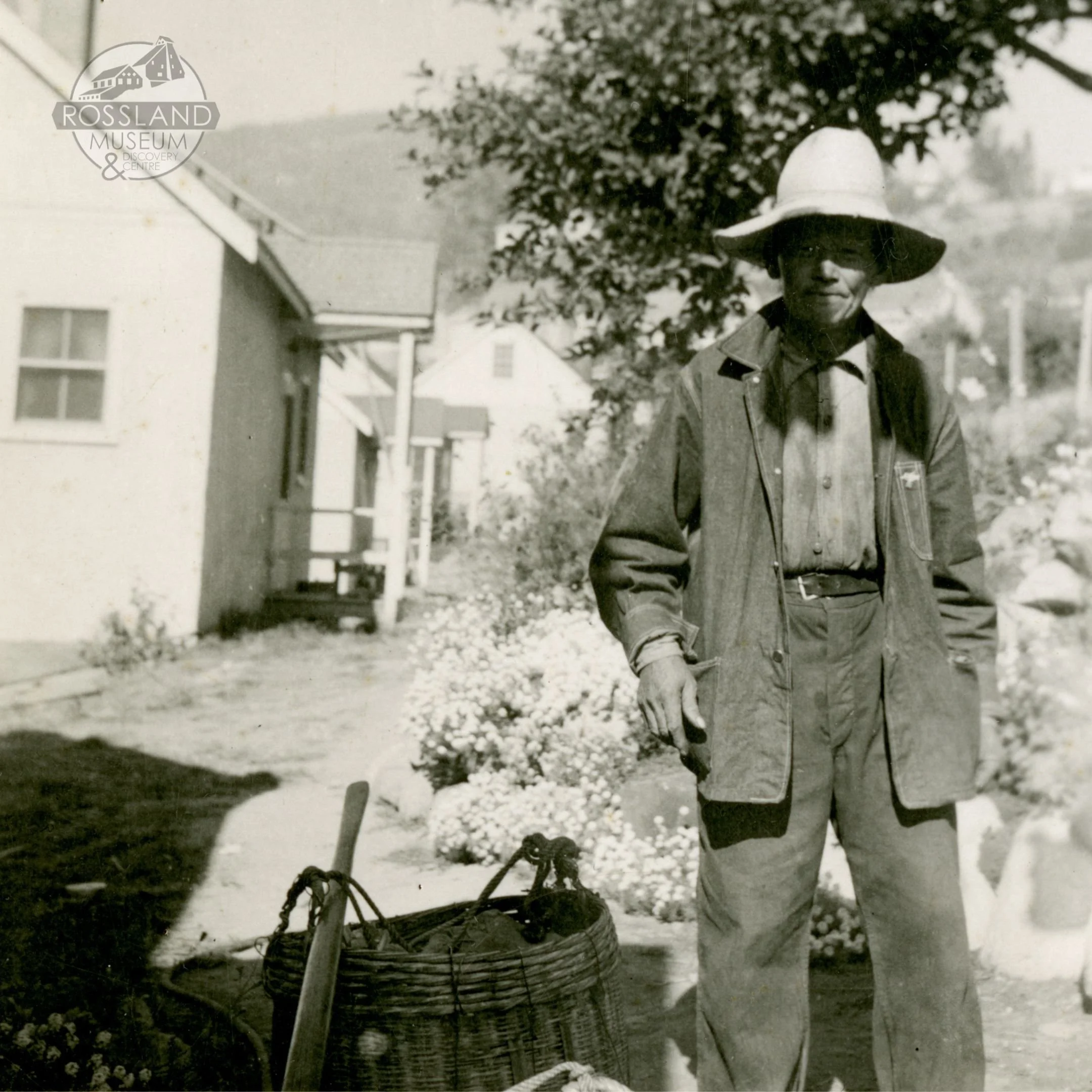
2309.0096: a Chinese farmer carrying baskets from Rossland’s “Chinese Gardens,” circa 1900
Which traditions and holidays does your family observe? How far back do they go, and where did they originate? For many Canadians, traditions are inherited, carried across oceans by parents, grandparents, and earlier generations. One such tradition is Chinese New Year. As a half-Chinese Canadian, my family carried this celebration with them through migration. Traditions like these are part of a much larger story of cultural continuity, connecting people to places, histories, and identities across generations.
More than a century ago, Chinese migrants living in Rossland sought to do the same. Early Rossland had a significant Chinese population, yet their stories are often absent from popular histories. Despite living thousands of kilometres from China, Chinese residents of Rossland continued to celebrate Chinese New Year, adapting their traditions to their new environment. Prejudice and discrimination confined many Chinese residents to the margins of Rossland society, both physically and socially. They lived largely segregated from other Rosslanders, and as a result, their lives were rarely documented except through a lens of racism, suspicion, or curiosity.

Fu Hung Company Catalogue from the Ming Cn Company in Rossland circa late-1930s
Newspapers such as the Rossland Miner, written primarily for white Canadian audiences, recorded some aspects of Chinese life, but these accounts were shaped by bias, misunderstanding, and racial prejudice. They offer an imperfect and often distorted window into the past.
Chinese New Year celebrations are among the few moments when Chinese residents appear in Rossland’s historical record in any meaningful detail. By examining these accounts critically and comparing them to traditional celebrations, we can better understand how Chinese migrants preserved their cultural identity. Despite discrimination and isolation, they maintained their traditions, adapted to new conditions, and built community far from home.
Note: Historical sources referenced in this essay contain racist language and reflect anti-Asian prejudice common in early twentieth-century Canada. While offensive terms have been omitted here, acknowledging their presence is necessary to understand the broader historical context.
The Holiday

Chinese Zodiac. Image by RootOfAllLight, via Wikimedia Commons
Chinese New Year, also known as Lunar New Year, marks the beginning of a new year in the Chinese lunisolar calendar. The date in Gregorian calendar notation shifts each year, typically falling between late January and mid-February. Each year is associated with one of twelve zodiac animals, forming a repeating cycle that has shaped Chinese culture for centuries. For example, you may have heard of a given year being described as the “Year of the Rat” or “Year of the Ox.”
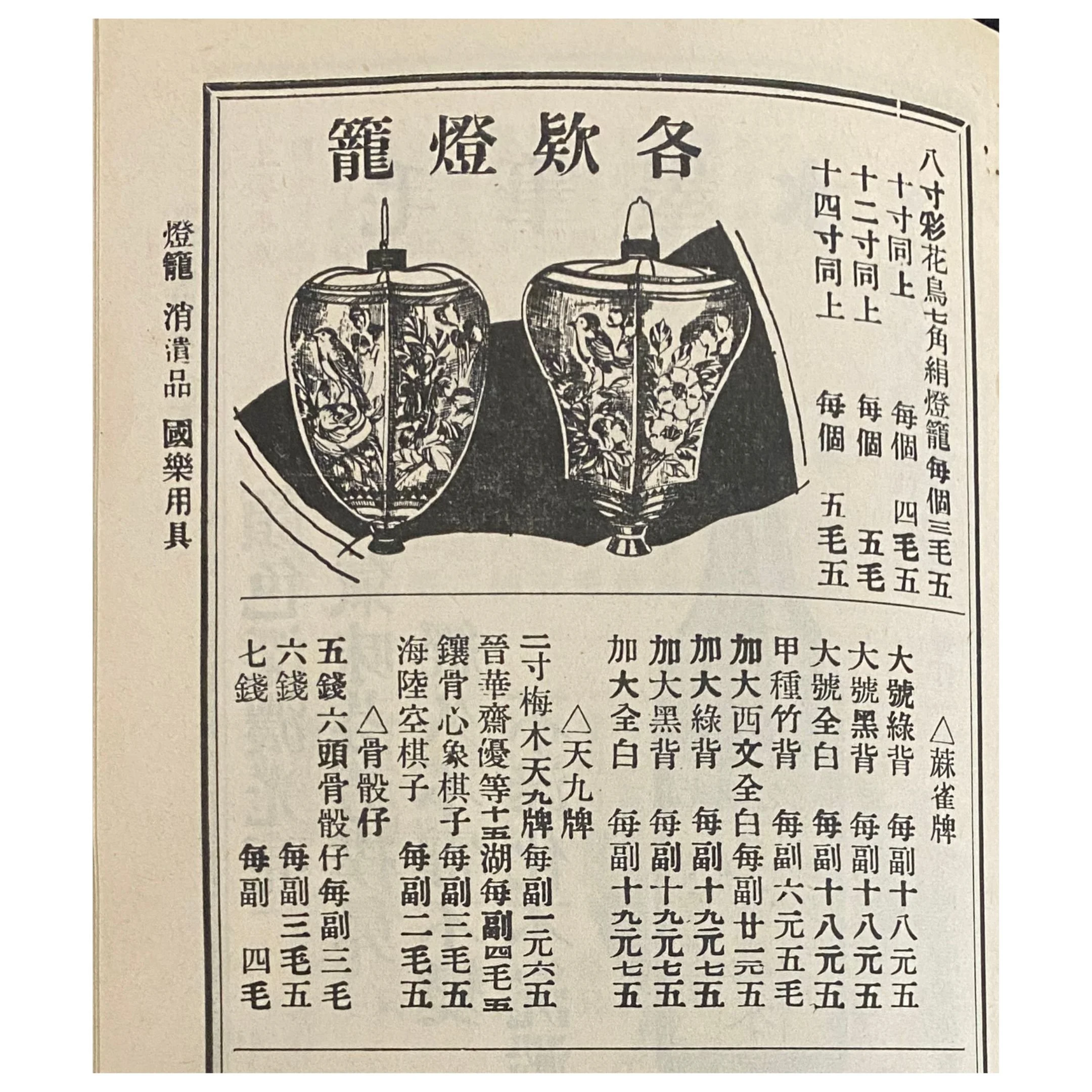
Fu Hung Company Catalogue, featuring lanterns
The holiday traditionally unfolds over fifteen days from the start of a new year, and is one of the most important celebrations in Chinese culture. This overview focuses on widely shared traditions, though customs vary by region and family. Many practices centre around attracting good fortune and driving away bad luck. Red decorations are hung in homes, and people wear red clothing, as the colour symbolizes prosperity, happiness, and protection. Firecrackers and the colour red are used to scare away evil spirits, particularly the mythical monster Nian, whose name is also the Chinese word for “year.”
Family and community gatherings are central to celebration. Relatives and friends come together to share food, drink, and conversation. Much like turkey at Thanksgiving, certain foods are closely associated with Chinese New Year. Most commonly, fish is a centrepiece dish, representing prosperity, given it is a homophone with the Chinese word for abundance. Many Chinese New Year dishes incorporate a symbolic meaning, whether in shape or in a homophone. Long noodles are a common presence at the table, representing a long life. Dumplings with various fillings represent wealth as they resemble Chinese gold and silver ingots, and have been considered auspicious since the Ming Dynasty (1368–1644 CE).
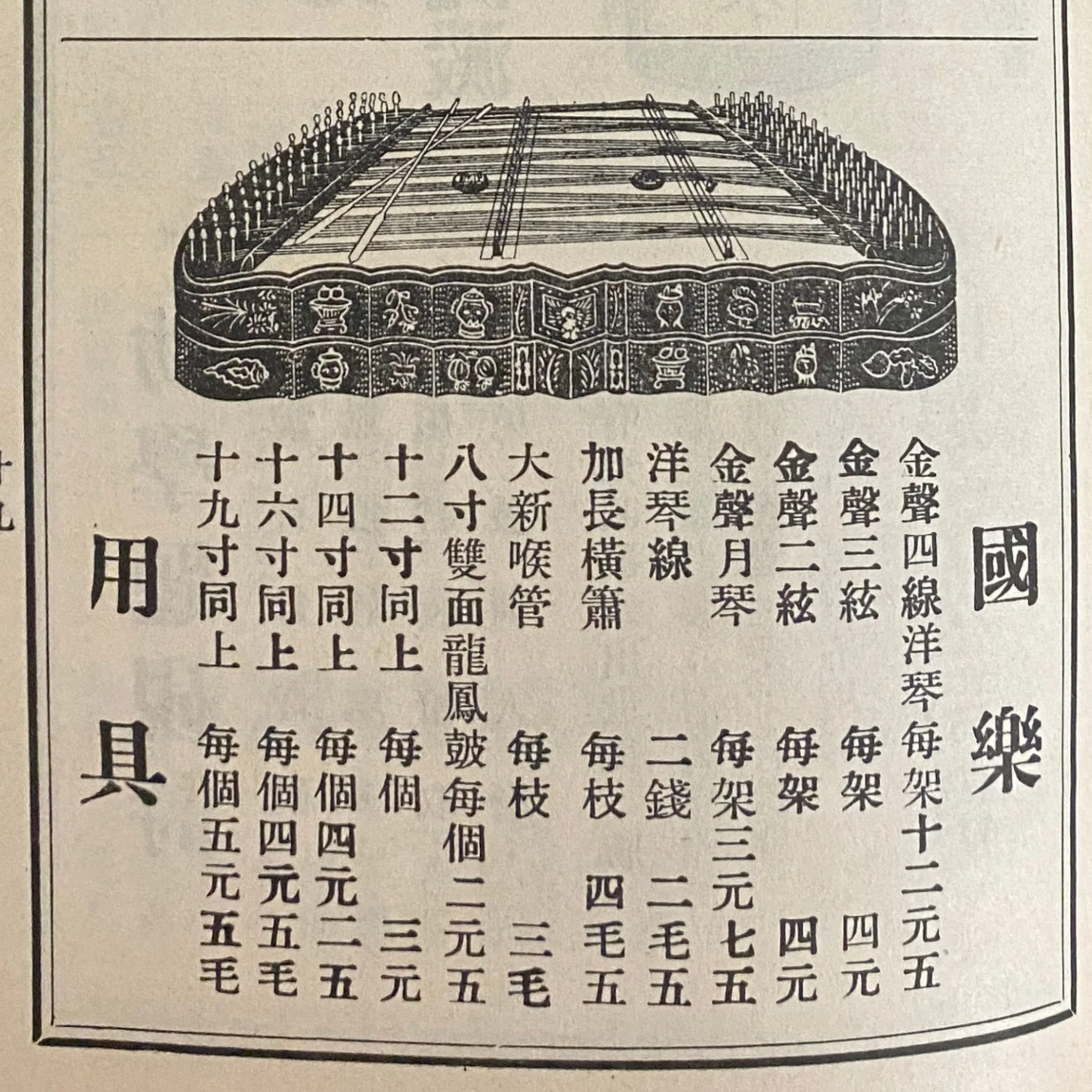
Fu Hung Company Catalogue, featuring a yangqin (musical instrument)
It’s also common for Chinese New Year meals to involve foods that are most commonly served in high-profile or prestigious events; shark fin soup and sea cucumber can be expensive banquet foods that may be odd to many Western palettes, but are delicacies for some families. Within my family, it was also traditional to have citrus fruits like mandarin oranges or pomelo, as well as snack boxes full of candies, nuts, and roasted sunflower and watermelon seeds. Those ingredients, however, are ones from celebrations I had either back in Mainland China, Taiwan, or in places in North America with more reliable access to those more traditional ingredients. Can we say the same about the Chinese residents living in early Rossland, a rural, mountain community, far from the major centres even today?
These traditions are storied and have been practiced for hundreds of years. Homes are cleaned thoroughly before the New Year to sweep away bad luck and make space for good fortune. Celebrations also frequently involve providing offerings to ancestors by burning incense and joss paper (papers that spiritually represent real money). It is also common to gift red envelopes containing money to young children - and sometimes to friends and acquaintances.
Chinese New Year is, above all, a communal celebration. It reinforces family ties, strengthens social bonds, and affirms cultural identity. Wishing friends and relatives “Gong Xi Fa Cai” (Mandarin) or “Kung Hei Fat Choi” (Cantonese) is offering a celebratory greeting and well wishes for prosperity, equivalent to the Christmas “Happy Holidays” or “Merry Christmas.”
Chinese Life in Rossland
By the early 1900s, Chinese migrants formed a small but significant portion of Rossland’s population. Census records and government reports indicate that between 3 and 7 percent of Rossland residents were Chinese. Unlike many European or American migrants, however, Chinese residents faced severe legal and social restrictions.
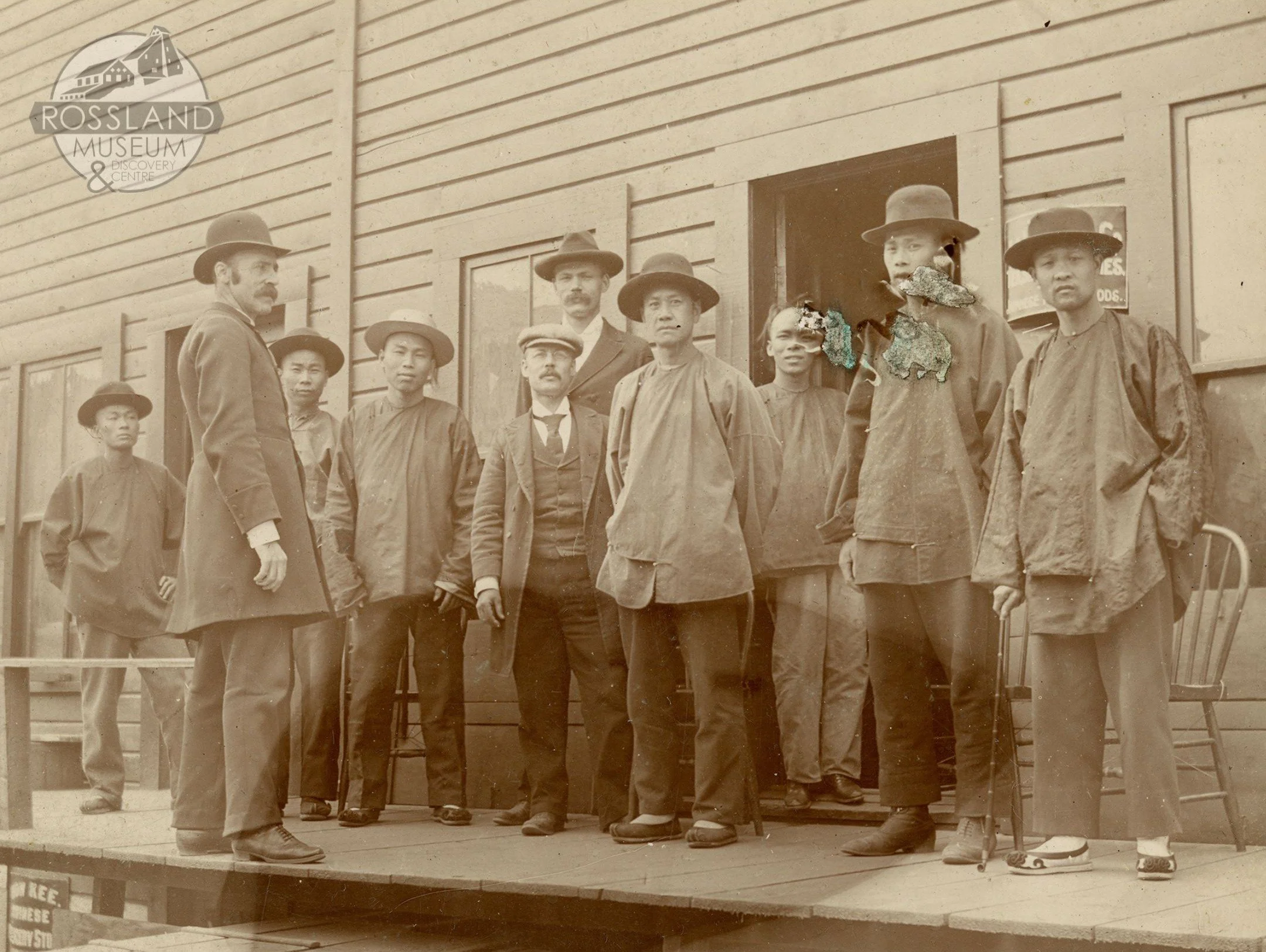
2282.0049: Group of men gathered outside Kee Chinese Store, July 1898
The Chinese Immigration Act of 1885 introduced a $50 head tax designed to discourage Chinese immigration. By 1900, the tax grew to $100 for every Chinese immigrant, making it prohibitively expensive for most families to immigrate together. Across Canada, Chinese men soon outnumbered women by nearly twenty-eight to one. In early Rossland, the Chinese population was almost entirely male. Many of these men worked to send money back home to their families in China, often hoping to eventually bring their families over, though many never could.
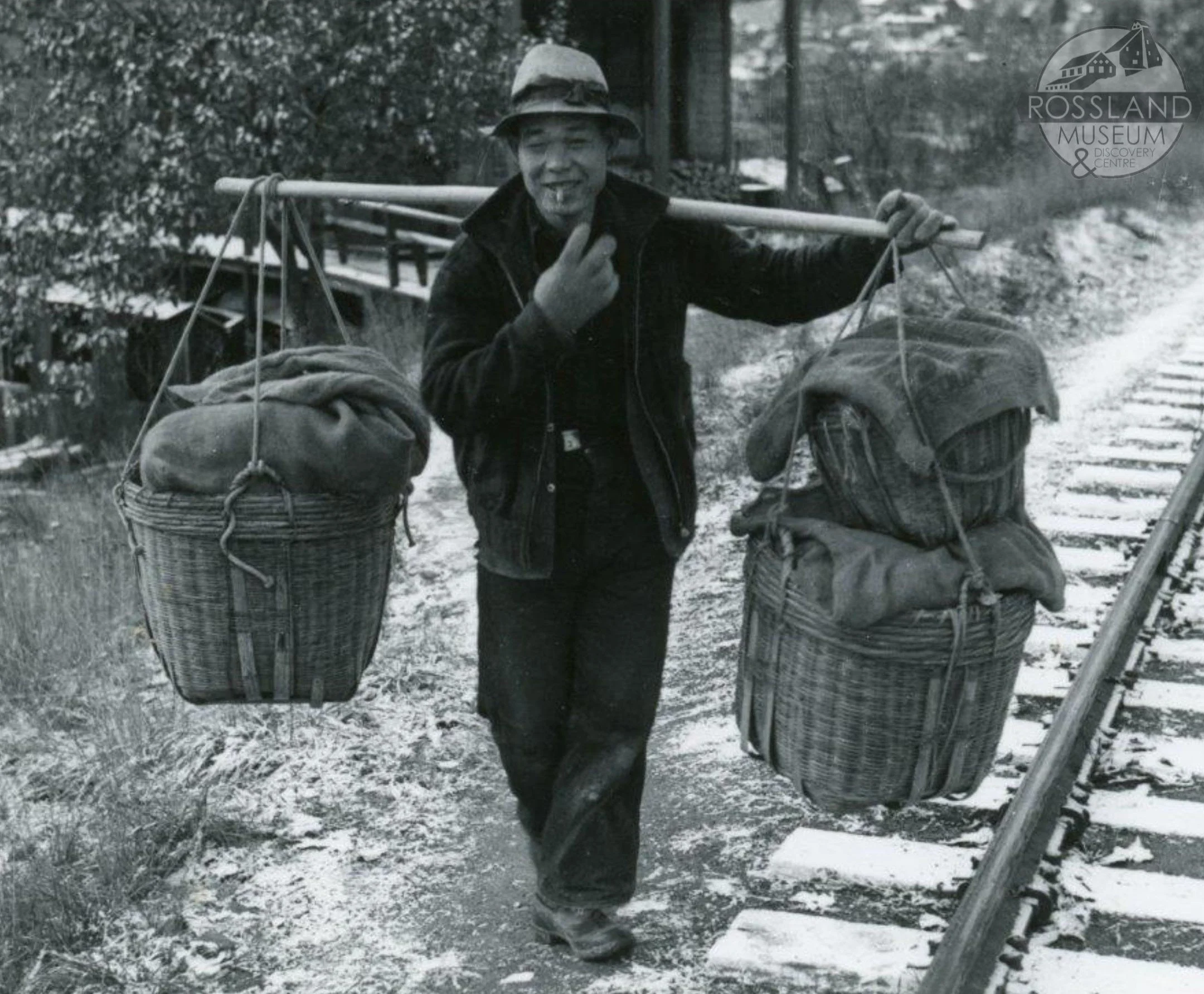
2313.0359 Lui Zui, circa 1940
Only a very small portion of Chinese migrants worked in the mines – 2 of 231 Chinese residents, according to the 1901 Census. The Metalliferous Mines Act, passed by the British Columbia government in 1897, banned Chinese or Japanese workers from working in underground mines. While this ban wouldn’t necessarily have prevented employment of Chinese migrants in company roles above-ground, there was strong opposition to Chinese workers from the Miners’ Union at the time. Mine managers claimed that the Chinese residents were wholly unsuitable for mining work. Combined with widespread racism and labour opposition, this forced many Chinese migrants into occupations such as launderers, cooks, gardeners or farmers, and general labourers. These jobs were essential to the functioning of the city but were undervalued and stigmatized.
The 1901 Census also provides some insight into the living conditions for Chinese Rosslanders at the time. Many of these workers lived in Rossland’s Chinatown, located around the eastern end of Lower Rossland’s Kootenay Avenue, between St. Paul and Monte Christo streets. Housing was crowded with an average of 1.9 men per room in Chinatown, and even 3 or more per room in certain buildings. However, less than 40% of the total population actually lived in this designated Chinatown. Others lived on business premises, farms, as live-in cooks or domestic workers, or in lodgings outside of Chinatown.

2021.18.1 Dale Matthews painting of the home of Rosslander Lui Zui, or “Louie Joe”
The population was further segregated in 1902 with the passing of the “Laundry Bylaw,” (Bylaw #83), which restricted the construction of new laundries north of Kootenay Avenue. By 1911, the majority of Chinese migrants were living in Chinatown, with much of the rest living in the western laundry area. This can best be understood as the creation of “a cognitive and physical barrier” between the Chinese migrants and the rest of society; as the geographer Michael Ripmeester observed, the sharp slope of Rossland’s geography kept them out of sight.
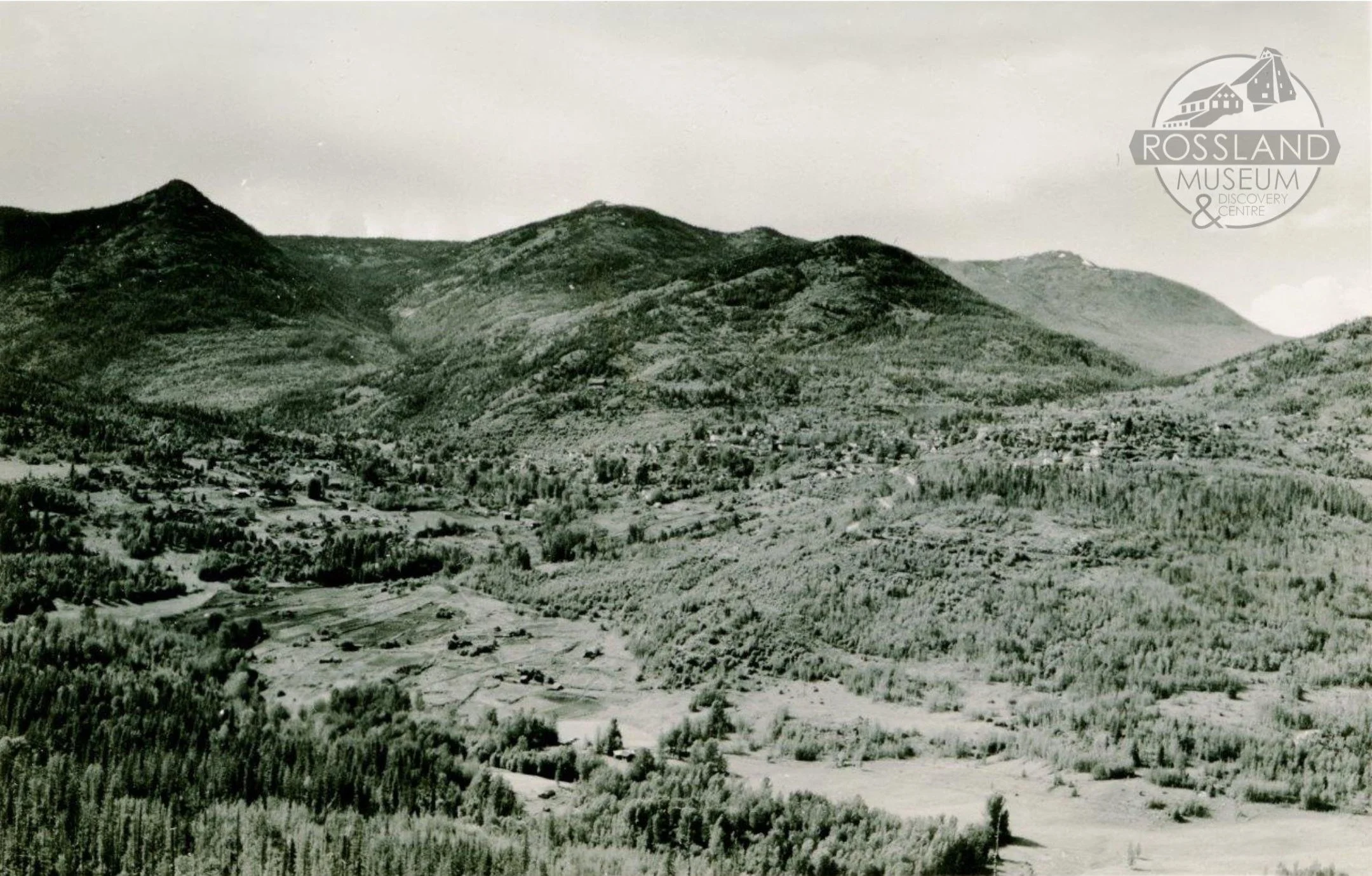
2311.0032: View of Rossland showing Chinese Gardens, 1943
The 1902 Report of the Royal Commission on Chinese and Japanese Immigration includes testimony from Rosslanders and white settlers across BC that Chinese immigrants offered unfair competition to white workers, due largely to their willingness to work in more menial jobs for lower wages. Some white settlers recognized that these workers filled a niche in the labour market that would otherwise be difficult to fill. Edmund Kirby, manager of the War Eagle and Centre Star mines, commented, “There are enough [Chinese] throughout the west to provide domestic service and do laundry work, and, in short, work of the class that white labour is reluctant to undertake.” However, many Rosslanders agreed that Chinese immigration should be restricted or eliminated entirely, and considered Chinese immigrants as “undesirable.” The reports are consistent, with miners, managers, union secretaries, and lawyers/political leaders espousing, at minimum, a distaste and distrust for Chinese workers. These opinions cited in the Royal Commission Report indicate a significant anti-Asian prejudice present across different strata of society.
The Rossland Miner also reflected the general prejudice of local white settlers with consistent anti-Chinese rhetoric. Many news stories published in the Miner were given biased headlines, used a variety of racial slurs, sensationalized trivial events involving misfortune for local Chinese workers, and expressed intense racism regarding the state of Chinese businesses and the quality of products and labour. Rossland’s Chinatown was presented as a place of both physical and moral decay, and at the same time, rendered a mysterious place separate from Rossland proper. This context is crucial to consider before we engage with some of the only available records describing how the Chinese New Year was celebrated by Chinese workers in Rossland: reports written in the Rossland Miner through the early 1900s.
Chinese New Year in Rossland

Fu Hung Company Catalogue Pages, featuring wine and tea
With the noted biases and a basic summary of New Year traditions in mind, I invite the reader to explore some excerpts from the Rossland Miner, detailing Chinese New Year celebrations. Take note of what is present, what is missing, and what could be misinterpreted through a biased lens. Any slurs will be edited out of the text.
“The [Chinese] New Year: Chinatown Observes the Beginning of New Year’s. The celebration attended by many curious white people – what the visitors saw:
The new year is the chief festival of the Chinese. On this day all accounts should be setted [sic] and the year begun with a clean balance sheet. [The typical Chinese person] starts in with a holiday, which is often prolonged over a week. Fire crackers are the outward and audible sign. Inside the houses the [Chinese person] proceeds to make merry with samshu, a fiery spirit distilled from rice. The object after the late dinner is to make one’s guests as inebriated as possible.”
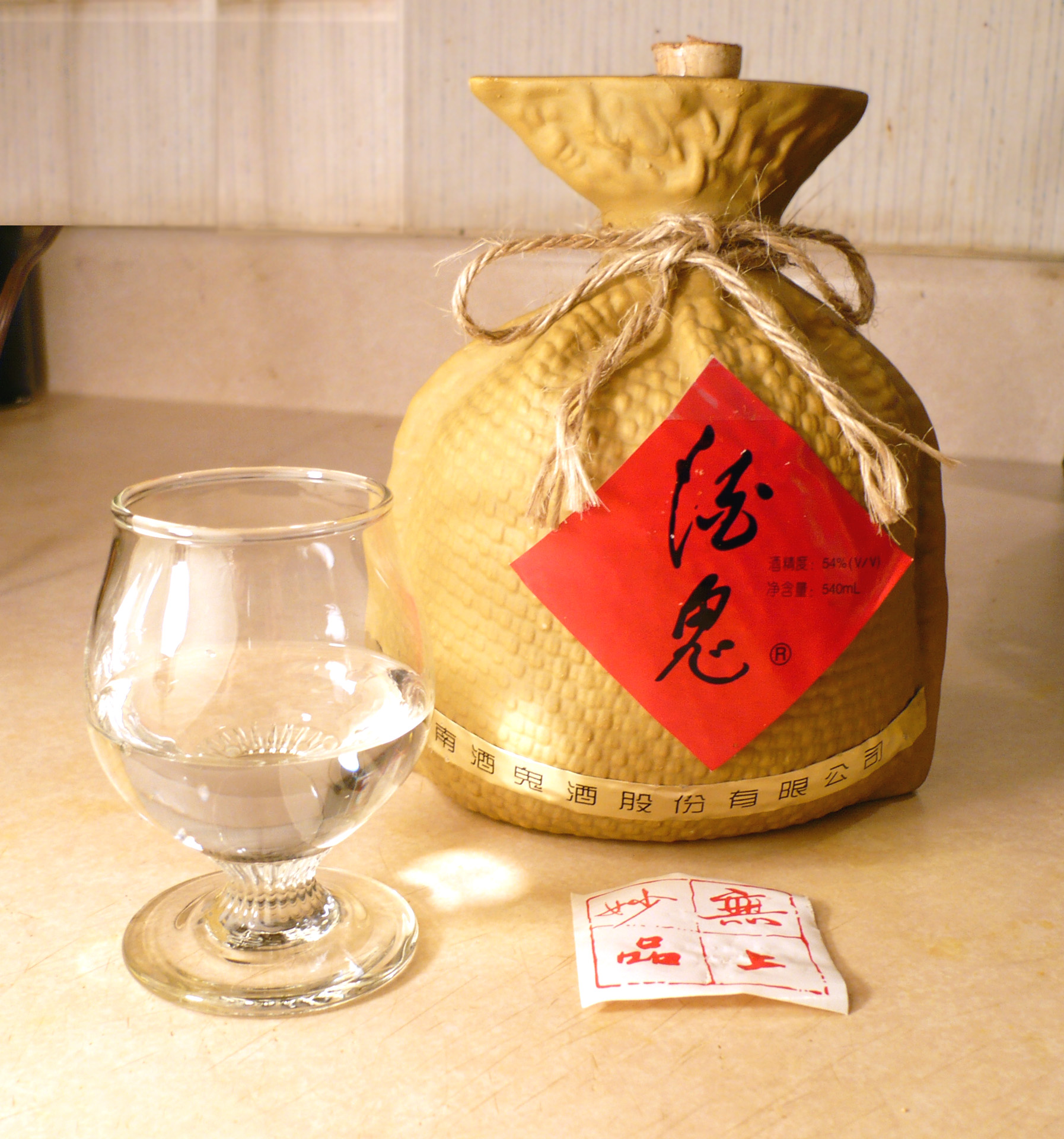
Baijiu. Image by Badagnani, via Wikimedia Commons
Without the slurs, this account is not a terrible representation of some of the traditions. Firecrackers, a late dinner, the drinking of ‘samshu’ (now better known as Baijiu, a distilled rice wine common in China), and the making of merriment align with communal spirit and celebration. Though typically a two-week holiday, indicating more than a week-long holiday is not an unexpected change, considering the community’s lack of leisure time and limited resources. The article continues:
“Yesterday calling was in vogue among the [Chinese] residents in Rossland, and the curious white man who called at any of the houses was made very welcome and had the most lavish hospitality urged upon him. If the caller was posted he said to his host on entering, ‘Kong E Fat Choi’ (Happy New Year) and immediately shook hands with himself warmly. When this was done properly, [the host] fairly bubbled over with joy, real or assumed, and smiling all over, as only a [Chinese person] can, he would grasp his own hands, exclaiming over and over again, ‘Kong E Fat Choi.’ The visitor was then invited to partake of refreshment, and in every Chinese shack yesterday, no matter how humble, a spread more or less elaborate, was laid out. It included Canadian whiskey and cigars, curious Chinese nuts and confectionery, some of the strange looking sweetmeats being very tasty liquors of various kinds in funny looking bottles, and a host of queer looking dishes that the white man knows not.”

Fu Hung Company Catalogue, featuring candied ginger and rice flour
The use of “Kung Hei Fat Choi” is a strong indication that these residents were Cantonese speakers. The clasping of hands is a common way to show respect in Chinese culture, especially in New Year’s greetings, though the non-specificity about how the hands were clasped makes further analysis more difficult. The hospitality presented here is a stark counterpoint to the general tone taken in most of our historic material. The usage of Canadian whiskey and cigars is likely an adaptation for local circumstances, but could also be a way to provide something more familiar to attendees.

Candy box. Image by Denise Chan, via Wikimedia Commons
It’s hard to know what the “curious Chinese nuts and confectionery” may have been referring to. They could be Chinese Hazelnut or Chinese Chestnut, but both are similar enough to their European or American counterparts that the extra curiosity seems unlikely. There could have been Gingko nuts, which have long been cultivated in China but are less familiar in other regions. My instinct is that it could even include watermelon seed or lotus seed. Without further details of which dishes were served, the unfamiliarity could mean the residents used odd ingredients, or just that the food was prepared in an unusual way. Regardless, this sort of open invitation to curious visitors is a rare instance of more direct interactions between the Chinese and non-Chinese residents of Rossland. Further along in this article, the writer mentions the absence of a joss house (a Chinese temple) in Rossland, but notes that a few joss sticks are burned in honour of particular gods. They were likely burning incense for gods, and I presume, for their ancestors.
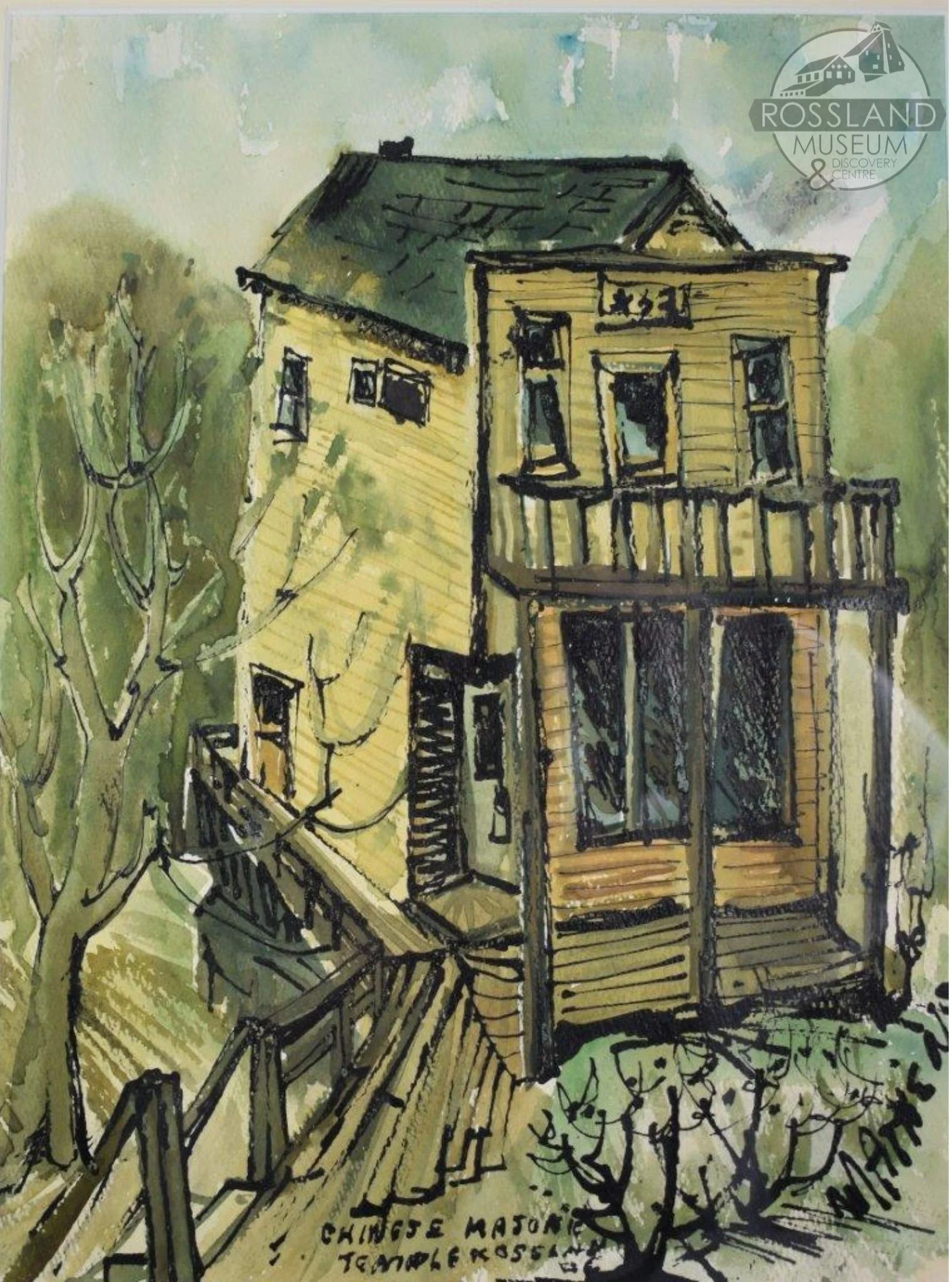
2021.18.2 Dale Matthews painting of Rossland’s Chinese Temple

Burning joss sticks. Image by Christopher Michel, via Wikimedia Commons
Two years later, the Miner reported:
“There is joy in Chinatown, for Thursday is the Chinese New Year’s day. The [Chinese] are already making preparations for the annual event, and when the red letter day arrives it is to be celebrated with all the proper accompaniments of clashing brass, much samsuey and endless rounds of visiting and interchange of felicitations. This is the one day of the year when the festive [Chinese person] takes a day off and relinquishes all ideas save those pertaining to his pleasure. At the Chinese stores ordinary merchandise is placed on the back shelves and the places of honor [sic] are given to firecrackers hung in hundreds on long strings, Chinese confectionery, sugarcane and other delicacies dear to the [Chinese] palate [sic]. … As usual the Chinese stores on Le Roi Avenue will be the centre of the celebration and the usual quota of white people will probably visit the [Chinese] during the day.”
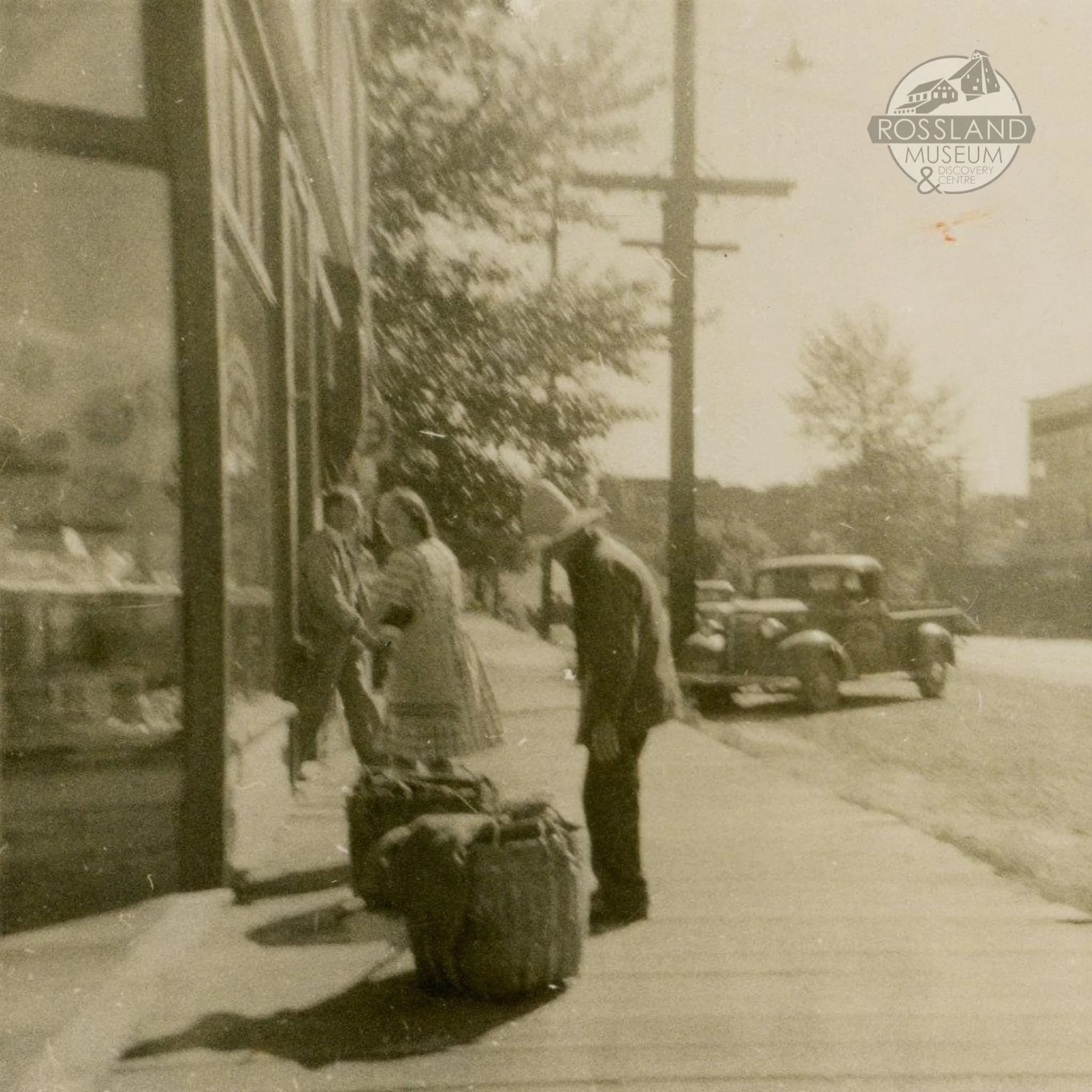
2317.0077: Chinese gardener on Columbia Ave between Queen and St. Paul streets, circa 1940s
Some expected features are included here, which helps us identify consistent features of New Year’s celebrations in Rossland. Firecrackers are mentioned again, and the “clashing brass” likely refers to gongs or cymbals being used to ring in the New Year. “Samsuey” is most likely Samshu/Baijiu, and the repeated vagaries of “Chinese confectionery” and “other delicacies” are familiar to us by now. Sugarcane isn’t one of the more traditional items from my experience, but it does play a significant role in the Hokkien traditions for New Year celebrations. Perhaps this is an indication that some of the Chinese migrants were from Fujian province. It could also be a misidentification by the observers; perhaps it’s actually bamboo, though not edible except in its shoot form. The “Chinese stores” of Le Roi are said to be the central hub, placing the celebrations in proximity to Chinatown. A “quota of white people” suggests that visiting this event has become something of a tradition for some of the white residents of the city.
“Coast papers report that carloads of Chinese dainties have been arriving this week to be later transhipped to customers all through the Kootenays, in preparation for the [Chinese] New Year. Canned goods with weird looking labels and containing shark’s fins, sea-slugs, bird’s nests and other wonderful products are among the goods, as well as many other things unknown even by name as articles of food to westerners.”

Shark fin soup. Image via Wikimedia Commons
Shipping specialty goods would have allowed for recipes closer to traditional meals, particularly with mention of shark fin, sea cucumber (presumably), and bird’s nests. Without additional examples, it’s hard to know the level of ingredient scarcity for local Chinese people. It’s possible that wealth disparity among the locals could further limit access to such items. I also recognize that the absence of Chinese women and children in the community likely affected the way meals were prepared, not to mention the impact on the celebrations.
“The celebration of Chinese New Year commenced on Sunday and extended over yesterday. In the Chinese quarter the celebration was marked by the feasting and manifestations of good fellowship characteristic of the occasion, and many citizens were the recipients of little gifts from [Chinese] acquaintances.”

Fu Hung Company Catalogue, featuring MSG and soy sauce
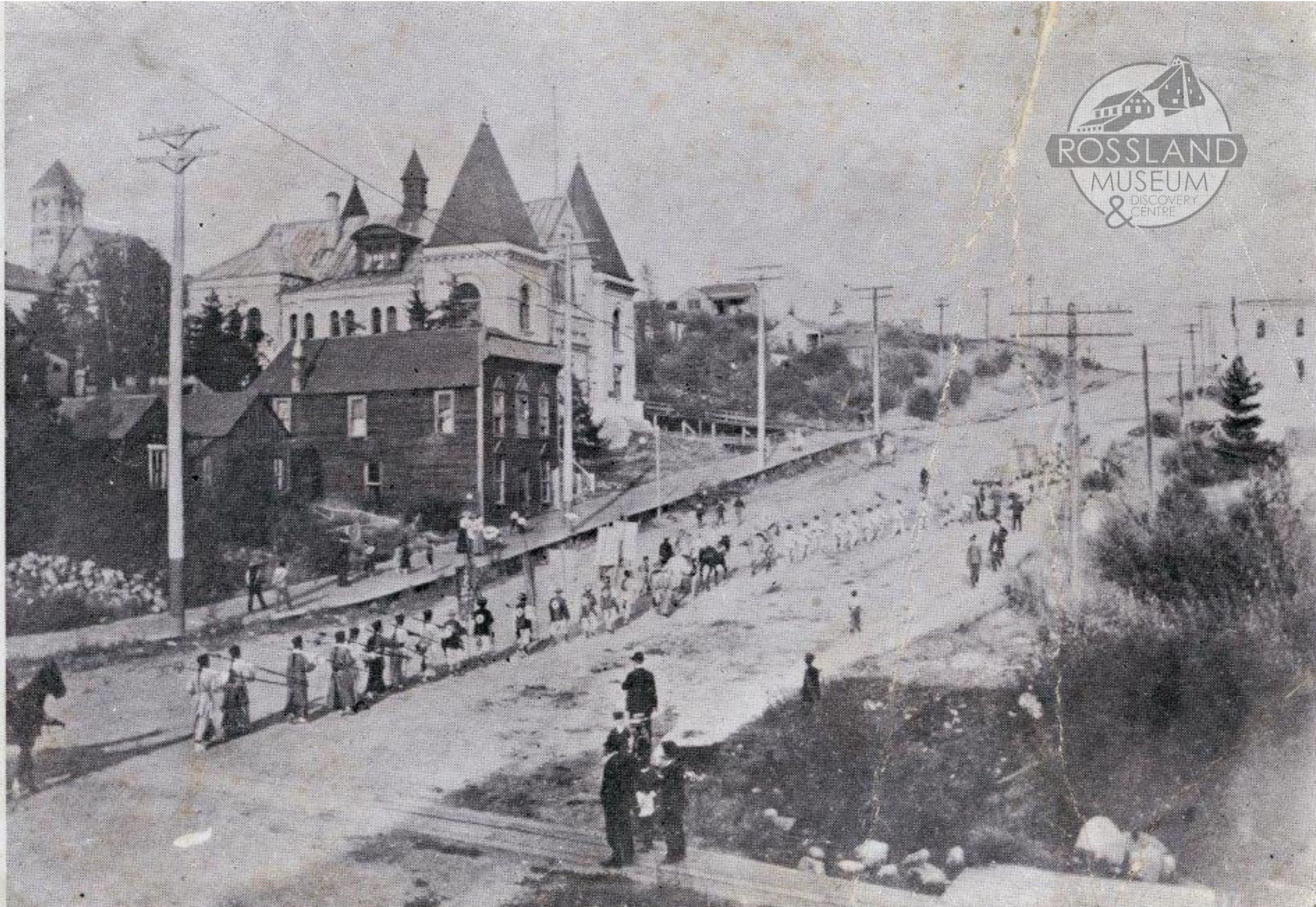
2368.0011: Chinese Parade on Columbia Ave, circa 1905
The giving of gifts is likely referring to the red envelopes and other gift-giving traditions associated with the Chinese New Year. This is another gesture of goodwill and merriment, though I note that the way this is worded using “citizens” seems intentionally distinct from the “Chinese acquaintances.” Regardless, this passage tells us that the festivities took place from Sunday to Wednesday that year, so it was only a three-day celebration.
Flipping ahead in the newspaper accounts:
“The [Chinese] of Rossland have been busy celebrating their New Years, starting in earnest Saturday at midnight, the [Chinese] settling down to a two days’ celebration declaring they would not ‘[work till tomorrow],’ and are keeping their word in most instances, as anyone knows who knows what the [Chinese] say generally goes. The ‘mayor’ of Chinatown says it is ‘[bad luck to work on New Year’s day],’ the [Chinese] taking a two day vacation this year, Sunday being a day of rest with them and they learning that they should observe two days when they can get an excuse.”
This 1918 article represents a major shift from the previous examples, written during an era of heightened racism and xenophobia in Canada related in large part to the First World War. The original text is extremely racist, with phonetic transcriptions deployed to further portray Chinese residents as the “other.” The New Year celebration is also presented as a holiday for the Chinese only, with no mention made of white people being invited to join the festivities. Referring to the “mayor” of Chinatown further highlights the division and barrier placed between Chinatown and the rest of Rossland. Much of the article expresses frustration with the Chinese not working, in contrast to just fifteen years earlier, when much of the racist rhetoric expressed in the Commission on Chinese and Japanese Immigration dealt with white settlers’ perception that Chinese immigrants offered unfair competition in the labour market by living too frugally and working too hard. The 1918 two-day celebration is even shorter than the celebrations mentioned in the 1904 passage, let alone the notion of celebrating as long as possible in 1902. My takeaway from this article is a growing prejudice towards the Chinese, likely a result of further barriers put in place years prior.
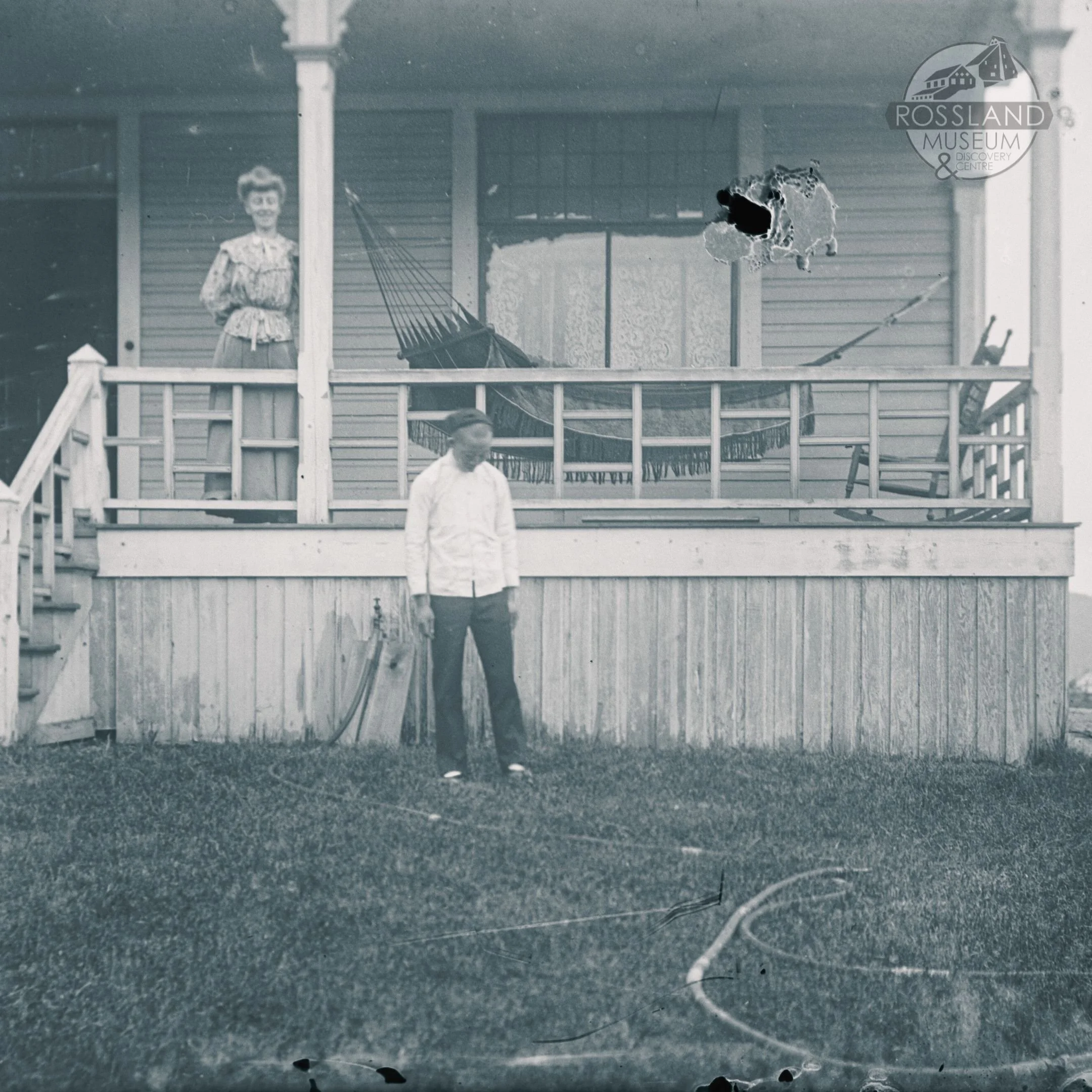
A1987.055.024: Ethel McDonald and Chinese worker at 2066 Earl St, circa 1910s
The attitudes and perceptions of non-Chinese residents clearly changed over the years covered in my research. Whether or not the invitations extended to non-Chinese Rosslanders were an attempt to bridge a gap and share in community, the noted decline in them is indicative of a deteriorating relationship. I suspect that these celebrations continued as always, but reporters simply had less and less direct experiences to record in the newspaper and other sources. The increase in marginalization of Chinese residents thus reduced their “relevance” to the wider city. I tried locating later references, but past the initial glut in the early 1900s, they thin out drastically.
A2021.014.001: Chinese gardener known locally as “Happy,” on Irving Ave, circa 1950s
Where does this leave us? I came into this research project anticipating more alterations or substitutions to Chinese New Year traditions in early Rossland. This was based on my own experience and difficulty in finding items I would need to celebrate my own traditions while here in Rossland. In truth, it seems they didn’t have significant trouble finding many of the most important items. I thought firecrackers and expensive items like shark fin and sea cucumber wouldn’t have been accessible, and while the biased descriptions we do have are still frustratingly vague, the presence of Chinese sweets and rice wine seem to have been fundamental. Canadian items were also included, such as Canadian whisky and cigars. These could be an adaptation due to availability or simply meeting other residents where they were. Chinese residents of Rossland extended invitations and traditional auspicious greetings, as well as shared in their communal spirit and relaxation. In short, the reports of Chinese New Year aligned with one central motif: this holiday was indeed celebrated appropriately in Rossland by the local Chinese residents, and it was an unrelenting and important event. With all of this considered, I have no doubt that what enabled them to celebrate this holiday despite the adverse conditions was the community they built.
My own difficulties in securing supplies for my New Year celebrations are a consequence of a relative absence of community; Chinese people make up less than 1% of the population of present day Rossland – another ramification of the head tax and other barriers designed to limit long-term Chinese settlement. Early Chinese Rosslanders built a community, and with that, a market for traditional items, and the willingness to assist one another in acquiring the materials necessary fore the New Year. I couldn’t find a record of precisely what they were eating, but I have some guesses; possibly fish (salmon, if local), possibly noodles, but it was perhaps too out-of-the-norm through the lens of the Miner’s writers. It is quite possible some of them were able to enjoy shark fin or bird's nest soup!
Gong Xi Fa Cai/Kung Hei Fat Choi. Happy Chinese New Year, everyone!
More Information:
Chinese Canadian Museum (Vancouver, BC)
Canada’s first museum dedicated to the history, heritage, and contributions of Chinese Canadians.Odysseys and Migration exhibition (Royal BC Museum)
A major exhibition on Chinese migration and community history, developed with the Chinese Canadian Museum and hosted at the Royal BC Museum.Chung | Lind Gallery (UBC)
A unique and extensive collection of research items related to early British Columbia history, immigration and settlement, particularly of Chinese people in North America and the Canadian Pacific Railway Company.
Chinatown Storytelling Centre (Vancouver, BC)
Museum focused on personal stories of Chinese Canadians, with exhibits and interpretive programming.
Chinese Canadian Stories (UBC Library Open Collections)
Digitized archival material documenting Chinese Canadian lives, migration, and community history.
Chinese Canadian Artifacts Project
Collaborative artifact database from museums across BC documenting Chinese community history.Chinese Canadian Historic Places Map (Heritage BC)
A cultural map highlighting provincially recognized sites of Chinese Canadian heritage in British Columbia.Chinese Head Tax and Chinese Exclusion Act (Canadian Museum for Human Rights)
An essay discussing some of the discriminatory policies that affected generations of Chinese immigrants to Canada.
Victoria Chinatown Museum (Victoria, BC)
A museum to share the history, traditions and culture of early Chinese Canadians to Victoria.